- Accueil
- > Shakespeare en devenir
- > N°19 — 2025
- > Shame and Humiliation on the Contemporary Stage: Playing Malvolio/a in the 21st century
Shame and Humiliation on the Contemporary Stage: Playing Malvolio/a in the 21st century
Immersion au plateau
Par Méline Dumot
Publication en ligne le 15 octobre 2026
Résumé
This article reflects on two contemporary productions of Twelfth Night: La Nuit des rois, by Thomas Ostermeier at the Comédie Française (2019), and Twelfth Night by Simon Godwin at the National Theatre (2017). It especially focuses on the character of Malvolio (Malvolia in Godwin’s production) and the way shame and humiliation are represented on stage. It also wonders about the effect of the character’s mistreatment on the audience. First cast in the role of accomplices, spectators are indeed left with unease as the gulling of Malvolio turns to abuse. How is the character of Malvolio/a interpreted in both productions? To what end? What kind of relationship with the audience is programmed by the uneasiness created by the treatment of Malvolio/a? This study is based on a close analysis of both productions, and on their representation of Malvolio/a in a manner that weakens the play’s comedic tone.
Cet article se concentre sur deux mises en scène contemporaines de La Nuit des rois : Twelfth Night de Simon Godwin au National Theatre (2017) et La Nuit des rois de Thomas Ostermeier à la Comédie Française (2019). Il réfléchit tout particulièrement au personnage de Malvolio (Malvolia dans la mise en scène de Godwin) et à la manière dont la honte et l'humiliation sont représentées sur scène. La réflexion proposée s’intéresse également aux réactions des spectateurs face aux mauvais traitements que subit le personnage. D’abord complices, les membres du public sont confrontés à eux-mêmes lorsque la duperie infligée à Malvolio bascule vers l’abus. Comment le personnage de Malvolio/a est-il interprété dans ces deux mises en scène ? Dans quel but ? Cette étude s’appuie sur une analyse approfondie des deux mises en scène et sur leur représentation ambivalente de Malvolio/a, qui affaiblit le caractère comique de la pièce.
Mots-Clés
Table des matières
Article au format PDF
Shame and Humiliation on the Contemporary Stage: Playing Malvolio/a in the 21st century (version PDF) (application/pdf – 636k)
Texte intégral
1“I surmise that the ultimate effect of Twelfth Night is to make the audience ashamed of itself”; “Malvolio does not merely upstage the comedy of the main plot: he notoriously disrupts the festive spirit of Twelfth Night. The unrecoverable ‘I’ll be reveng’d on the whole pack of you’ (V.i.377) troubles all the charm and delight that critics and audiences have found in the play”.1 These two statements, respectively by Ralph Berry and Dympna Callaghan, are the starting point of the reflection I will develop in this article. According to them, Shakespeare’s comedy concludes on a bitter note and, as Berry notices, lays emphasis on shame rather than merriment for the spectator. First cast in the role of accomplices, spectators are left with unease as the gulling of Malvolio turns to abuse. This interpretation of the text is notably reflected on the 21st-century stage by two productions: Twelfth Night, by Simon Godwin at the National Theatre (2017) and La Nuit des rois, by Thomas Ostermeier at the Comédie Française (2019).2 In Ostermeier’s production, Malvolio (played by Sébastien Pouderoux) commits suicide, and his lifeless body is revealed, hanged, as the backstage panel opens at the end of the play. In Godwin’s rendition of the play, Malvolio is reimagined as Malvolia and is played by the actress Tamsin Greig. This re-gendering lends a darker, homophobic overtone to Maria’s prank, and the performance also ends with Malvolia, who is seen ascending stairs under the rain. Through a detailed analysis of the two productions’ representations of Malvolio/a, I aim to question the notion of shame, both as it is represented on stage and as it is supposedly triggered in the audience. As Ewan Fernie3 points out, shame is a core concern in Shakespeare’s plays: “Shakespeare uses the word ‘shame’ 344 times and the word ‘guilt’ only 33 times”.4 This is not surprising, since guilt has to do with the violation of the law: its assessment can only be part of a legal system. Theatre, however, is no tribunal, despite Olivia’s intention to make Malvolio “both the plaintiff and the judge” at the end of the play (5.1.348).5 The notion of shame, on the contrary, is crucial. According to Nancy A. Cluck, “[s]hame arises from internal ambiguities; the person who experiences it finds within himself something which does not match his standards of acceptance. No one else need be present; no other person need witness the exposure, for the central element in shame is the exposure to self”.6 Shame holds a significant place in Twelfth Night particularly when considering Malvolio, as Allison P. Hobgood explains: “[i]n Twelfth Night, many of Shakespeare’s characters experience shame, but none so thoroughly as Malvolio, who is subjected to harsh duplicity, imprisonment in a dungeon cell, and then a final, very public shaming endured at the play’s close”.7 But has Malvolio been shamed or humiliated? Shame is “[t]he painful emotion arising from the consciousness of something dishonouring, ridiculous, or indecorous in one’s own conduct or circumstances”, whereas humiliation is achieved through the act of making someone “low or humble in position, condition, or feeling”.8 As Phil Leask underlines, “[h]umiliation leads to a strong sense that one has been wronged, while shame involves a sense that one has done wrong and diminished oneself in one’s own eyes or in the eyes of others”.9 One might argue that Malvolio undergoes both: he has been “notoriously abused” (4.2.87-88 and 5.1.372), that is, humiliated, and will seek to be “revenged” on the “pack” (5.1.371). However, the character is also associated with a strong sense of personal shame, as he has tried to rise above his station and has made a fool of himself in front of his mistress. I will thus discuss the interaction between shame and humiliation in the two performances under study. The specific scenes concerned with Malvolio in Shakespeare’s play have strongly preoccupied Thomas Ostermeier and Simon Godwin in their productions. Following Berry’s assertion, the audience takes part and delights in Malvolio/a’s downfall, before, supposedly, feeling ashamed for their enjoyment of the servant’s mistreatment. How do two contemporary productions stage humiliating rituals, and what is the intended effect on their contemporary audience? I will focus on the characterization of Malvolio/a in both productions, triggering a comic effect, before examining Malvolio/a’s abuse. Ultimately, this analysis will lead to a reflection on the relationship between Malvolio/a’s humiliation and our contemporary understanding of shame.
Malvolio/a: an essential comedic source
2If both productions lead to Malvolio/a’s humiliation, this occurs only at the end of the performance. Malvolio/a first appears as a ridiculous character, whose gulling is particularly enjoyable. Ostermeier and Godwin do not shy away from mockery in their presentation of Malvolio/a, laying particular emphasis on the character’s physical appearance. In both productions, the servant is fully dressed in black, illustrating his/her rigid personality. Both directors chose to make Malvolio/a carry a black wig, with a pudding basin cut and bangs, imbuing the character’s face with severe features, as well as ridiculing his/her appearance. In the National Theatre production, Feste is also gendered as a woman and offers a vivid contrast to Malvolio. The fool is dressed in bright colors (green for her first appearance on stage, with a sparkling bodysuit, red tights and sparkling boots) and Olivia comes to her for comfort. In Act 1, scene 5, Feste takes her into her arms, thus building a strong opposition between a caring and nurturing fool and the bodily rigidity expressed by Malvolia, who sneers at the other characters present on stage. This contrast between Malvolia and Feste in Godwin’s production is reminiscent of the opposition between the natural and the artificial fool in the Renaissance. Paromita Chakravarti indicates: “it is the witty jester or the artificial fool with command over language and culture who becomes the humanist spokesperson, rather than the natural fool and his variants – the ‘monster’, savage, clown, wild man, bedlamite or native”.10 In Twelfth Night, Feste is presented as an artificial fool, amusing his listeners with his wit, whereas Malvolio, “sick of self-love” (1.5.86), could be characterized as a “natural fool”, funny despite himself. In Godwin’s production, the actress Tamsin Greig lays extra emphasis on harsh consonants: both her gestures and her speech are jerky, reflecting her severity and inflexibility. From the start, she is an object of laughter. When Olivia calls for her loudly (“[w]hat ho, Malvolia” 1.5.291), she emerges immediately from the shadows, leaving the audience to assume that she has been lurking in the dark during the previous scene, waiting to be called by her mistress. Once Olivia gives a ring to Malvolia so that the latter has to run after Cesario (1.5), the servant jumps and hops towards the door, making her look ridiculous and overzealous. Ostermeier’s Malvolio acts along the same line. Malvolio wears a black top without any bottoms except his underwear, a similarity he shares with all the characters in this production. However, he also wears a ruff, building a contrast between this formal element of costume and the absence of pants in his attire. The ruff helps to portray Malvolio as out of fashion, ill-fitted for the time he inhabits. Just like Malvolia, he is ridiculed through the way he hops and runs when he follows his mistress’s order. His exaggerated haste and eagerness display his zealousness to please her.
3Costumes and gestures thus present Malvolio/a in both Twelfth Night as a rigid character, obsessed with physical self-control, making him/her an object of laughter. The proud servant thus deserves his/her future punishment. According to Hobgood:
Malvolio spends much of Twelfth Night actively staging himself – ‘practicing behaviour’ – before an early modern audience (2.5 14). Initially, he performs a reserved, puritanical body that betrays none of the ‘distempered appetite’ that Olivia, for example, accuses him of harboring (1.5. 77-78). Much of his shame in the drama ensues, however, from his inability to act this Puritan part consistently, from a failure to play his role convincingly enough; his ambitions as an actor exceed his capabilities. Ultimately, spectators see through Malvolio’s erratic performance, labeling and judging him for what he most ‘successfully’ acts throughout the play: a duplicitous fraud and phony.11
4In both productions, Malvolio is betrayed by his/her body. Malvolia’s gestures, speech and dress appear exaggerated, as if she was acting the part of the Puritan badly. The controlled body then progressively betrays Malvolia, bringing a shift from initial ridicule to uncontrollable shame. In Ostermeier’s production, as Malvolio reads the letter (2.5), he covers himself with a leopard skin and imagines himself being superior to Sir Toby, acting this imagined encounter with wide, ample gestures and a scornful look. Malvolio’s initial rigidity is then fully transformed when he reappears onstage in front of Olivia (3.4), wearing a thong and a golden phallus. In Godwin’s production, the lack of control over the body is also expressed during the gulling scene. As Malvolia enters the stage, she barely contains her frustration when she notices that potted bushes are not correctly aligned and that the fountain in her mistress’s garden is broken. She then mimics Tai Chi breathing exercises to calm herself down. The body thus appears as a narrow container overflowing with emotions; control over her body indicates her desire to restrain herself in order to perform the role of the Puritan. During the letter scene, as she imagines Sir Toby bowing to her, she is explicitly rehearsing a performance, accompanying her monologue with corresponding gestures. This failure to contain both body and imagination is also to be linked with bodily humors, as Hobgood notices, “[u]nder his staged, puritanical façade in Act one, the choleric steward secretly suffers from extraordinary humoral unrestraint and uncontrol”.12 As Malvolio appears in his yellow stockings, the color of the yellow bile responsible for his choleric temper, his costume reflects what has been kept secret, hidden. In both productions, the body is ridiculed through a lack of restraint. Malvolio/a’s transformation triggers a strong comic effect, through the character’s extravagance and the exaggeration at stake in his/her physical behavior. Moreover, we might argue that a certain pleasure is at stake for the audience when seeing Malvolio/a’s loss of control as a harmless punishment for his/her previous contemptuous behavior and pride. This pleasure is reinforced by Malvolio/a’s relationship with the audience.
5In both productions, Malvolio/a builds a strong relationship with the spectators. In Ostermeier’s production, Malvolio talks to the audience as soon as he appears on stage. He first enters through the back of the house, on the platform that was built for the actors to walk across the auditorium above audience members.
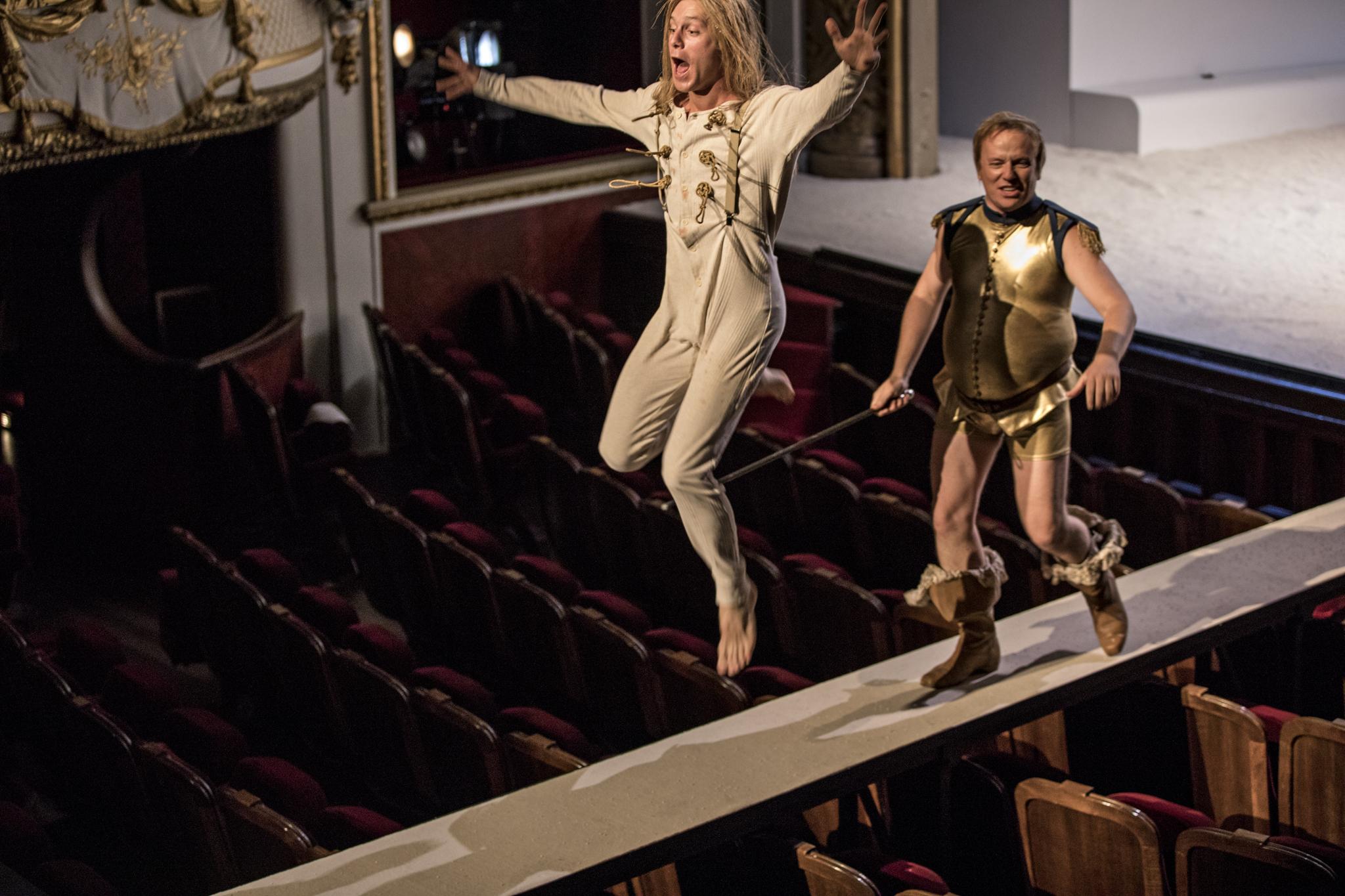
Fig. 1 : Sir Andrew (Christophe Montenez) and Sir Toby (Laurent Stocker) on the platform at the Comédie Française.
Crédits : Jean-Louis Fernandez.
6As he enters, he stares down at audience members, declaring deprecatingly “[e]h ben y en a du beau linge” (“[w]ell, look at all these fancy people”) and later on “c’est calme, c’est bien” (“you’re quiet, that’s good”). As Becky Kemper notes: “[a]lthough puritanical in opinion, Malvolio is also vain, pompous, and uncharitable, not to mention highly ambitious and covetous—in short, a hypocrite”.13 Malvolio’s vanity and uncharitable character are thus immediately expressed as he enters the theater. His first contact with the audience unravels through mockery, specifically that addressed to spectators of the Comédie Française, a theatre well known for being an upper-class traditional Parisian venue. When he criticizes the fool and the type of people who would laugh at “this kind of mediocre joke” (“ce type de blagues médiocres”), he points directly at the audience, emphasizing his disdain for them. When Feste, Toby and Andrew make a racket in Olivia’s house (2.3), Malvolio chides not only the characters but also audience members, reproaching their lack of respect for “the institution”. The entire letter-reading scene is addressed to the audience: a spectator is asked to decipher the M.O.A.I letters, for instance. Interestingly, in Shakespeare’s play, characters building a direct relationship with the audience often occupy the position of the Vice or the Fool14: in Richard III, Richard occupies the platea space as defined by Robert Weimann15, taking on the role of the “former Vice, inequity” (3.1.82)16 to enroll spectators in his scheming. In Twelfth Night, one might expect Feste to essentially occupy the platea space, however, in Ostermeier’s production, the artificial fool appears as another member of the household playing games with Maria and Sir Toby. On the contrary, Malvolio includes the audience in the play, as subjects he can freely chide. This liminal position reinforces Malvolio’s place as target: as he mocks the audience, the audience feels inclined to mock him in return. This specific relationship also takes place in the National Theatre production. As she reads the letter, Malvolia uses the audience as her confidant and addresses spectators throughout the scene. Audience members are first considered by Malvolia as subordinates. As she reads the letter and declares, “her C’s, her U’s and her T’s”, she casts a disapproving look at the audience when she hears them laugh, reprimanding them in the same way she did with her mistress’s servants. When she mentions “her great Ps”, she turns directly to one side of the audience and makes a gesture to forbid them to laugh, rolling her eyes at their immaturity. As Hobgood underlines, “[t]he steward’s humiliation requires quite literally an actor and an audience”.17 Here, the audience is not only on stage (Sir Toby, Sir Andrew and Fabian) but also in the auditorium, facing Malvolia directly. Being acknowledged by Malvolia, audience members are involved in a relationship with her, being put in the same position as Sir Toby, Andrew and Maria. However, this relationship quickly evolves. As she declares, “no one must know”, Malvolia orders the audience to keep silent, making them part of her secret discovery. The disapproving relationship transforms into a teasing one. As she points out “this is evident…” and then, after a pause, “…well, to any formal capacity” (2.5.115), she glares at the audience, implying that they would not be clever enough to comprehend the meaning of the letter. She then slowly explains the meaning of M.O.A.I as a professor would, dismissing her students’ capacity to understand and at the same time acknowledging them as being in her confidence. By the end of the scene, she cries, “[m]y lady loves me!”, stumps and sets off a fountain. She then directly connects with the front row of the audience, whispering “see, see!!” while gesturing towards the letter and the fountain, as if the fountain suddenly working was a sign of Olivia’s love. After having read and deciphered the letter, she smiles, throws water at audience members, and then walks directly in the fountain, becoming fully wet. This leaves her in a new position: her guard is down, her shirt becoming transparent, announcing a more fragile personality than her seeming rigidity led the audience to believe. The bond with the audience is reinforced when she appears in her yellow stockings. As ridiculous as she is, her self-affirmation is also encouraged by spectators: in the National Theatre’s filmed production, the audience applauds her as she appears onstage in her yellow stockings, as if to encourage or approve of her transformation. In both cases, Malvolio/a establishes him/herself in the platea space, commenting on her situation and position in the house directly to the audience. Malvolio/a’s dismaying attitude towards the spectators encourages the audience to laugh at him/her, and to enjoy the mockery he/she will be subjected to later.
7Whether it is with Ostermeier or Godwin, Malvolio/a truly reinforces the comedic tone of the play from his/her first appearance on stage until the yellow stockings scene. The arrogant Puritan, expressing his/her feeling of superiority and contempt for everyone, including audience members, triggers laughter and is harmlessly ridiculed through her transformation for her mistress. However, both productions move on to violence and abuse later in the play, as Malvolio/a is detained in Act 4, scene 2.
Malvolio/a’s violent abuse
8In Ostermeier’s Twelfth Night, the punishment in 4.2 is particularly violent. Malvolio is shown bound, almost naked. Sir Toby makes him endure what he calls “le supplice du caca” (“the poop ordeal”): what looks like feces is thrown at Malvolio’s body and face.

Fig. 2 : Malvolio during the “the poop ordeal” in Thomas Ostermeier's production at the Comédie Française.
Crédits : Jean-Louis Fernandez.
9As Malvolio kneels on the floor, one is reminded of the Latin root of the word humiliation (humus): the character, who desired to rise above his station, is brought to the ground, to the lowest level. During this scene, Sir Toby sodomizes him with a walking stick. At this point in the Comédie Française recording, one hears the fits of laughter suddenly dying in the audience. As Sir Toby declares, leaving the stage, “je trouve que ça devient dangereux de pousser le divertissement jusqu’au bout” (in Shakespeare’s text: “I cannot pursue with any safety this sport to the upshot”, 4.2.69-70), one feels that the “sport” has already gone too far. In Simon Godwin’s production, the scene is also marked by Malvolia’s deep vulnerability. Throughout the play, we see Malvolia shedding her clothes, changing from her very strict and covering black outfit to a Pierrot costume partly hiding her yellow stockings. Interestingly, through the Pierrot outfit, she is associated with the sad clown figure from the pantomime: casting away the Pierrot jacket could then represent her transformation from a sad to a happy clown, meant to smile at Olivia rather than share her sadness. During the imprisonment scene, she is only wearing yellow stockings and a corset, her reddened skin making the character appear as particularly vulnerable, as she is bound and blindfolded, sitting on a bar stool, which makes her seem particularly fragile and off balance. She recalls images of the goddess Fortuna, who is often represented blindfolded to symbolize the capricious nature of destiny. Malvolia has indeed tempted fate but is struck with misfortune.
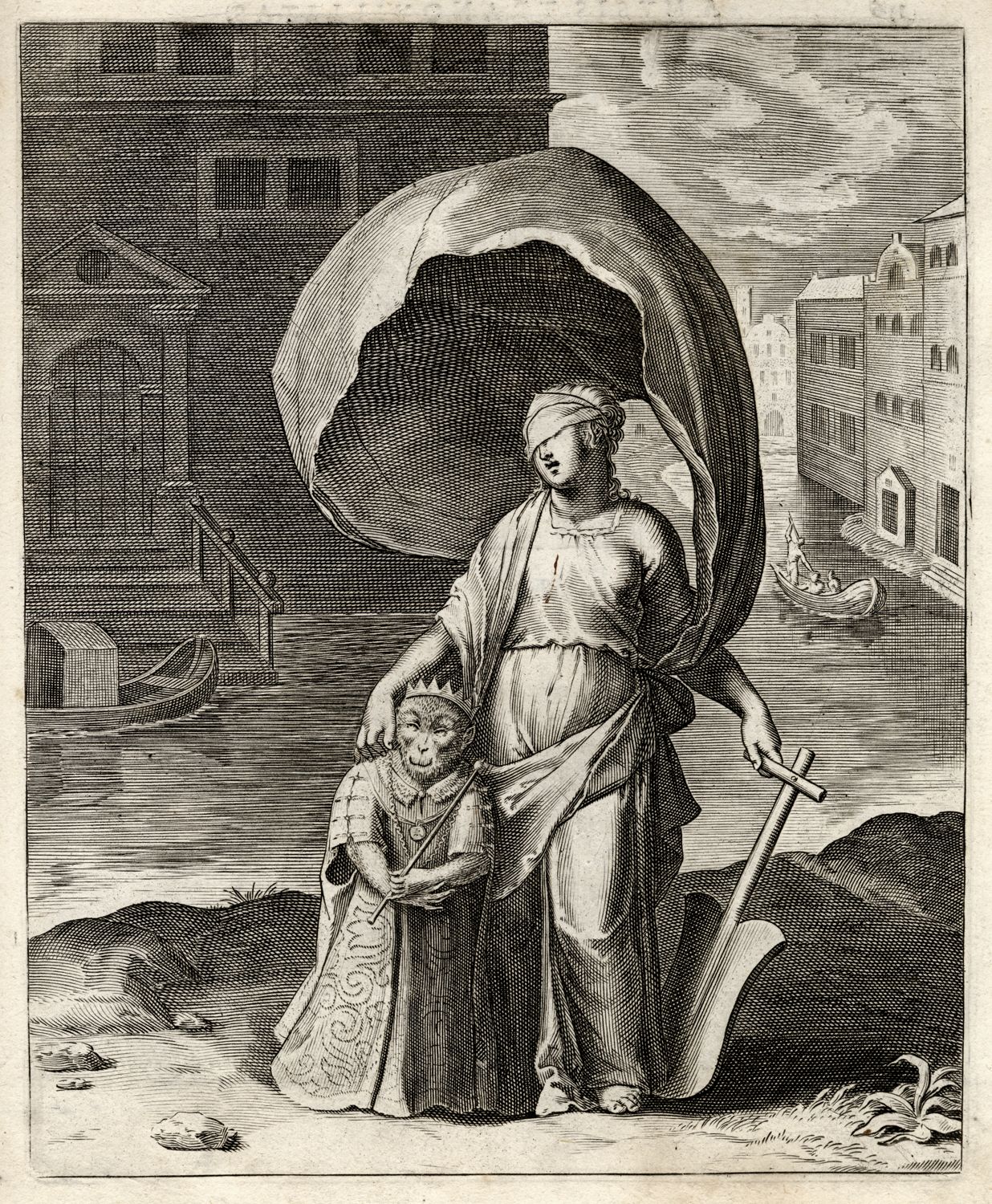
Fig. 3 : Otto Van Veen, Emblemata Horatiana, Otto Van Veen, 1612, STC 4863.5, page 254, image 063906.
Crédits : Folger Shakespeare Library.
10In both plays, the humiliation Malvolio/a is submitted to is strongly physical, exposing his/her body to the audience. The humiliating exposure of the body then leads to a sense of personal shame, as Malvolio/a is confronted to a diminished image of him/herself. As Helen M. Lynd underlines:
Experiences of shame appear to embody the root meaning of the word to uncover, to expose, to wound. They are experiences of exposure, exposure of peculiarly sensitive, intimate, vulnerable aspects of the self. The exposure may be to others but, whether others are or are not involved, it is always […] exposure to one’s own eyes.18
11In both productions, the body is exposed and wounded. As Fernie reminds us, “shame more than any other emotion entails and is partly experienced as a sense of nakedness and a horror of exposure”.19 In Ostermeier’s production, all the characters are partially clothed. Yet, this semi nakedness does not involve shame for the other characters. On the contrary, they seem to be characterized by their shamelessness as they pursue their own interests with complete disregard for others. Only Malvolio appears truly naked as he kneels defenseless during his imprisonment. As noted by Kemper, the mistreatment of Malvolio in contemporary production is particularly violent, contrary to what the text suggests: “[w]hile the overall lesson or trick may be harsh, Malvolio’s physical handling is not”.20 In fact, the first Folio stage direction, “Malvolio within” (Twelfth Night, Folio I, 1623, Act 4, scene 2),21 implies that Malvolio’s mistreatment is not visible on stage22, but “[i]f the audience cannot see Malvolio or his pained reactions, they do not sympathize with his plight, and the scene becomes a showcase for a clown”.23 Therefore, in both productions, Malvolio/a remains particularly visible, an element shared by most contemporary performances of the play. This visibility necessarily leads to a form of violence. Kemper remarks:
In order to ensure that an onstage Malvolio cannot see, the director must blindfold, cage, restrict, or cast into extreme darkness the poor steward, which strengthens the very empathy that his specified absence reduces. A director must also find a way to bring Malvolio onstage, usually bound, led, dragged or thrown, which negates the textual references to gentleness that Shakespeare wrote with intention.24
12In Ostermeier’s production, the stage is only lit by a blue light and Malvolio’s eyes are covered with excrement, while in Godwin’s, the scene is dark with a single spot of light showing a blindfolded Malvolia. In each case, the character is physically restricted. Here, the exposure of the vulnerable body can be interpreted as a direct attack on the self. Fernie notes: “[w]ith its involuntary desires, its blemishes, wounds and diseases, its excrement, and its eventual death, the gross, steadily decaying body irresistibly offends the sense of self […]”.25 In Ostermeier’s production, the use of feces to degrade Malvolio emphasizes this sense of the body as a disgusting, decaying element of human life. The character is deeply shamed, as he is associated and confronted with a degraded sense of the self. The rape of Malvolio in Ostermeier’s production, absent from the original text, ties in with the early modern meaning of the word “abuse” used by Malvolio and Olivia during the play. The Oxford English Dictionary points out that “‘abuse’ would have resonated on a specifically corporeal register in the early modern period: ‘to be wronged, done violence to, violated’”26. This violence is also reinforced, in both productions, through gender reversal.
13In Godwin’s production, Malvolia is re-gendered: but in Shakespeare’s play itself, the question of gender and gender reversal is already present, as Dympna Callaghan has shown: “Malvolio’s cross-gartering, his ‘transvestism’ is, then, structurally and symbolically related to gender inversion, and it is no further removed from anatomical inscription than is Viola’s disguise”.27 Callaghan makes it clear that, “[i]n accordance with its carnival theme, female genitals are at the heart of Malvolio’s gulling”.28 As Malvolio spells the letters C.U.T., he becomes “feminized, ridiculed, castrated; his corporeal being in its entirety has been reduced to the most denigrated body part – a ‘cut’”.29 This feminization of Malvolio’s body is thus illustrated in Ostermeier’s production: Malvolio’s rape and penetration turn him into a feminized victim. However, the character remains associated with a masculine notion of shame. Fernie points out: “[i]f Shakespeare, then, has an encompassing concept of shame as opposite to being, it is nonetheless strongly gendered. What is shamefully degrading for a man is loss of power or authority, position or self-command”.30 Whereas the “basis of female shame is unchastity or a reputation for unchastity” in Shakespeare’s plays, Malvolio is shamed through his loss of self-control and authority over himself.31 Moreover, his shame is to be considered from a different perspective because of the character’s re-gendering in the National Theatre play. In Godwin’s production, Malvolia’s love for her mistress is no longer only associated with her desire to change her social status, but also with the recognition of her homosexuality. As Malvolia first appears on stage, she is so constricted by her clothing that her yellow stockings appear as a form of liberation. One could consider Maria’s letter as the outing of the character’s homosexual desire. In the production, when Feste, Sir Toby and Sir Andrew make a great deal of noise in the house (2.3), the revolving stage reveals Malvolia sitting by her mistress’s bed as she is asleep, bringing her a cup of tea. This silent scene is, on the one hand, comic, showing Malvolia’s exaggerated involvement and care for her mistress but on the other hand, it hints at her homosexual desire for Olivia. Just like Ostermeier’s, Godwin’s imprisonment and abuse scene is deeply disturbing. It is permeated with sexist and sexual violence, as we see a woman tied up and blindfolded, in a fully vulnerable position, recalling Sir Andrew’s desire to “beat the rogue” (2.5.30). As Feste (also gendered as a woman) torments her, she grabs Malvolia’s breasts, clearly staging a scene of sexual abuse. When Malvolia is made to kneel on the floor and sobs pitifully as the fool leaves her, the scene is devoid of any comic effect, pointing, as in Ostermeier’s production, to the humiliation of the character. Sophie Duncan has thus described the production as “inadvertently homophobic”.32 Peter Kirwan notes about the Pierrot the clown outfit:
turning Malvolia into a clown sidesteps the opportunity either for a more serious treatment of the misogynist homophobia directed at her (especially in the ugly but unremarked moments of Daniel Rigby’s Sir Andrew desiring to punch her for expressing her desire for a woman) or for a more sincere treatment of her love.33
14As Kirwan and Duncan have underlined in their criticism of the play, the production makes several references to drag culture and queer love. However, Godwin does not follow through: in the end, Malvolia is abused and rejected without any deeper reflection on what this abuse entails, and the other queer characters (in this production, Sir Andrew Aguecheek and Antonio) are also left to their loneliness. In the case of Malvolia, we may wonder whether her homophobic punishment is indeed inadvertent, or if it rather aims at shaming the audience, following Berry’s interpretation - quoted in the introduction to this article - of the ultimate effect of the play.
Shaming the audience
15Are audience members of Twelfth Night truly ashamed of themselves at the end of the play? And is this the aim of Shakespeare’s text? According to Kemper, “Shakespeare created Malvolio as a hypocritical Puritan and overly ambitious social climber that his audiences most likely would have scorned and hated”.34 Malvolio is humiliated by Maria’s prank and then seeks revenge without transforming his excessive self-love. Kemper recalls that Malvolio’s abuse was inspired by a far crueler theatrical punishment:
The same theatrical device appears in Barnabe Riche’s Farewell to Military Profession, where a husband treats his scolding wife as if she were mad. However, the source is far more brutal. Her dissembling husband and a group of neighbors chain the wife’s leg to the floor, bind her arms, scratch her with brambles and shout prayers at her.35
16This depiction, if not present in Shakespeare’s text, is strongly reminiscent of contemporary productions and their treatment of Malvolio. The idea that the audience might feel ashamed is thus linked more with the way Malvolio’s character is treated on the contemporary stage than with Shakespeare’s play. Indeed, shame, and, more specifically, public shame, played an important part in the early modern era, through the use of “the stocks, the pillory and the whipping post”.36 Interestingly, John Manningham’s account of the play points to the fact that the gulling of Malvolio was considered as a central point of the performance rather than a subplot.37 If “[p]ublic beheadings and hangings were a familiar London attraction”,38 then the humiliation of Malvolio might have appeared as a habitual spectacle: in the “atmosphere of raging shame”39 that characterized early modern England, the shameful mistreatment of Malvolio was an enjoyable distraction. Fernie notes that “[a]nother indicator of shame’s lively presence in Renaissance literature is its frequent and vivid personification”.40 He adds:
In The Alchemist, the hilariously oblivious Dapper, believing he is about to be interviewed by the Fairy Queen, is blindfolded, bound, pinched, robbed, gagged with a piece of gingerbread and locked in a privy for two hours, where he is almost stifled. He gets a brief visit from a whore, wriggles on his knees before her as instructed and kisses her ‘departing part’ (5.4.57): he emerges in a state of beatification.41
17Malvolio’s punishment appears as a mild trial in comparison. Might this scene of punishment, then, serve a comedic function on the early modern stage, rather than seeking to provoke shame in the audience? Berry’s assertion, in my opinion, is founded on modern sensibilities rather than on early modern ones. Kemper also remarks: “Feste’s nonsensical catechism of the supposedly mad Malvolio begins to appear in a context of good-natured fun, not extreme torture; and torture was something that Elizabethans knew about”.42 However, on the 21st-century stage, the effect of Malvolio’s gulling and punishment on the audience is not so clear. The “common recreation” (2.3.132) and “sport royal” (2.3.167) of Malvolio’s gulling are still funny to today’s audiences but the imprisonment and punishment scene might be more problematic. According to Schiffer, both plots (Olivia, Viola, Orsino and Sebastian on the one hand, Sir Toby, Sir Andrew Maria and Malvolio on the other) in Twelfth Night are funny; yet, one veers “toward the winter of realism, irony, satire and the ‘expulsion’ of Malvolio”.43 The ambiguous nature of the comedy might also reside in our contemporary relationship to laughter. Patrice Pavis uses the expression “laughter in retreat” to define it: “at the risk of over-generalizing, it has to be said that we do not laugh much in contemporary performance”.44 He further explains, “[i]n a society that is fragmented into hermetically sealed classes, with many different interest groups, clans and multiple identities, we cannot expect to find any recognizable and common target”.45 The Puritan Malvolio, punished through a shaming ritual, fails to trigger unanimous laughter on the 21st-century stage. Humiliation is no longer a comic device: it triggers our unease, or our shame, as Berry points out, which is reinforced by the violence usually seen in contemporary performances of the play. Kemper reminds us that, “[h]owever used, Shakespeare’s stage direction [‘Malvolio within’] provides the strongest evidence yet that he did not intend to interrupt his lyrical comedy with the psychological torment of a noble victim by a nihilistic anti-clown”.46 And yet, in the two productions under study, it is clear that Malvolio becomes a helpless victim.
18This is reinforced by both productions’ final scenes. In Ostermeier’s production, Malvolio does not come back to the stage in 5.1 after his humiliating imprisonment. Olivia seems to vaguely recall the letter he sent her, but Malvolio never gets the opportunity to confront “the pack” (5.1.371) responsible for his humiliation and to promise revenge. According to Hobgood, this scene is crucial:
His demand for redemption and righteousness of course calls attention to his egocentric gullibility but, more importantly, marks publicly the cruel actions of his beguilers. He attempts to shame them by exposing their “sportful malice” and by forcibly requiring them to recognize their accountability”.47
19In Ostermeier’s work, Malvolio is denied the possibility of accusing his abusers. The play ends in confusion. Olivia, Viola, Orsino, Sebastian and Antonio all begin to kiss each other, looking simultaneously charmed and perplexed. As the kissing scene comes to a close, the backstage panel is removed, and one sees Malvolio walking up a stepladder and putting a rope around his neck. In the recording of the performance at the Comédie Française, one can hear the audience starting to laugh nervously and then stopping, as Malvolio steps off the ladder and stays hanging, dead. The recording ends with a close-up shot on Olivia’s face, who covers her mouth in shock. Malvolio’s suicide illustrates the workings of shame, as Fernie describes it: “[i]f shame as a recognition of falling short is a revelation of our mortal condition, as an experience of disintegration it resembles and anticipates death itself. For shame is a spiritual death. This is evident in ordinary language: ‘I was mortified’, ‘I could have died of shame’”.48 Contrary to humiliation, which would lead the victim to seek revenge, shame has no way out and its only outlet seems to be suicide. Indeed, Fernie points out that shame “generates the wish not to be what one is or has become, which in extreme cases may lead to suicide, but may also motivate reformation and rebirth”.49 In Ostermeier’s proposition, shame has overcome Malvolio and the only way out is death, in order to escape the deep humiliation he has been put through. Malvolio is not treated as a figure who can unify the audience through laughter, and spectators are unified in their response to the surprising, maybe shocking suicide of the character on stage. In Godwin’s production, Malvolia follows a different trajectory at the end of the play, revealing a distinct understanding of shame and humiliation. According to Fernie, shame involves breaking apart the false version of oneself, dispelling illusions, and is a way of reaching truth and discovering one’s real self.50 In Godwin’s production, Malvolia comes to the stage after her imprisonment and looks with bewilderment at her mistress, as she realizes that Olivia does not love her. The most shameful moment happens in this realization and self-awareness, as Malvolia understands that she has ridiculed herself in front of her mistress. She promises revenge, but at this point, she also takes off her wig, revealing short blond hair, and the close-up shot on her face shows streaks of tears and make-up, emphasizing that she has stopped playing the role of the Puritan. This vulnerable and stripped self symbolizes the character’s renewal. As Fernie writes: “[s]hame is among the most intense and painful of our human passions. It is also one of the most interestingly ambiguous; for although it can inhibit, constrain and even destroy a person, it can also cause them to reform and begin a new life”.51 This reformation is at stake in Godwin’s production. In an interview given about the play, the actress Tamsin Greig compares her character Malvolia to a grain of popcorn: the very tight and unbreakable grain will explode under the heat of a tiny glimmer of hope and love. The character is also described in this interview as “exposing herself and peeling layers after layers”.52 The actress explains that the aim of the humiliation scene is to confront the character with the feeling of being controlled, since Malvolia is elsewhere constantly controlling herself and her environment. At the end of the play, the stage revolves, showing images of marital bliss from the two couples, as Malvolia sits, dejected on the stairs. When Feste sings “the rain it raineth everyday” (5.1), Malvolia ascends the stairs, first walking with great difficulty, as if she had been physically hurt. This image of ascension reminds us of Malvolia’s humiliation: when she was kept blindfolded, she was kneeling on the ground, hinting metaphorically at the character finding herself at her lowest point; however, at the end of the play, she goes up, creating an image of hope and renewal. Then, as she gets to the top of the stairs, she raises her arms, as if to embrace the rain, in a position that seems victorious, as the other characters stand under the rain holding black umbrellas. The performance ends with this last image, as a black out plunges the stage into darkness. Malvolia’s characterization in Godwin’s play seems to illustrate that “shame is an important human experience, because flawless integrity is an impossible dream”.53 As Fernie adds, “shame points the way beyond selfishness to relationship with the world outside the self”.54 Through humiliation and shame, Malvolia has let go of the control she exerted over herself, and the last image points to a sense of liberation or, at least, evolution for the character. Contrary to the end of Ostermeier’s production, the audience might not feel any sense of shame here, as the character claims her new self in the final moment of the performance. As the punishment and shame Malvolia undergoes are linked to her homosexuality, it remains unclear what the production aimed to achieve, and to what extent the homophobic tone of Malvolia’s punishment was intentional, in order to create a sense of shame in the audience. And yet, one might argue that, in both productions, unease is triggered. Through the violent treatment and abuse of Malvolio/a, spectators are not allowed to laugh completely freely at Malvolio/a’s punishment. Malvolio’s suicide directly points to the egoistical and indifferent nature of the other characters and denounces the complicity of the audience in Malvolio’s humiliation. As for Godwin’s Malvolia, the underlying homophobic aspect of her punishment might also aim at our embarrassment: despite the character’s evolution, the end of the performance still leaves room for discomfort, as heterosexual couples are seen celebrating their love, while the queer characters end up alone and excluded.
20If shame is too strong a word to define what audiences have felt at the end of Ostermeier’s and Godwin’s productions, one cannot deny that a sense of unease permeates both performances, particularly when the play comes to a close. Fernie underlines that “[w]e are all humiliated in the fall, the shameful death of the champion; it is a revelation, a vicarious experience of universal shame, and in a Christian context a re-enactment of the original Fall”.55 Yet Malvolio is no champion, and even his suicide on Ostermeier’s stage does not bring any clarity to the way we are supposed to feel about this character. If the ritual of public shame in the Renaissance, as well as the stage direction “Malvolio, within”, lead us to believe that humiliation aimed at straightforward laughter and enjoyment in the early modern period, our own relationship to shame and humiliation seems more difficult to clarify. Godwin’s and Ostermeier’s productions do shed light on the impossibility of laughing comfortably at Malvolio in the 21st century. If Manningham’s account hinted that Malvolio’s gulling was the main interest of the play, our contemporary uneasiness with humiliation and shame also puts Malvolio to the front of the stage. The cruel treatment to which Malvolio/a is submitted on the contemporary stage does not necessarily lead to a sense of shame in the audience but reveals both directors’ unease at treating Malvolio/a as a simple joke. This is, however, not always the case. In Tim Caroll’s all-male production of Twelfth Night for the Shakespeare’s Globe in 2012, Malvolio (played by Stephen Fry) appears on stage in a box partly hidden under the stage. At some point, Maria lets a few drops of wax from her candle fall into Malvolio’s box, but he is not physically attacked as he is in Godwin’s or Ostermeier’s production. Throughout the play, his gulling emphasizes the comedic aspect of the play, rather than taking on a darker shade. The way Act 4, scene 1 is performed on the 21st-century stage is thus deeply revelatory of directors’ intents and visions of the comedy, rather than of any shaming rituals inscribed in the text.
Bibliographie
ASTINGTON, John H., “Malvolio and the Dark House”, in Shakespeare Survey: Volume 41: Shakespearian Stages and Staging, vol. 41, 1989.
BERRY, Ralph, Shakespeare and the Awareness of Audience, London, Routledge, 1985.
CALLAGHAN, Dympna, “‘And All Is Semblative a Woman’s Part’: Body Politics and Twelfth Night” Textual Practice, 7, n°3, 1993, p. 428-452.
CARNEGIE, David, “‘Maluolio within’: Performance Perspectives on the Dark House”, Shakespeare Quarterly, 52, n°3, 2001, p. 393-414.
CHAKRAVARTI, Paromita, “Natural Fools and the Historiography of Renaissance Folly”, Renaissance Studies, 25, n°2, 2011, p. 208-227.
CLUCK, Nancy A, “Shakespearean Studies In Shame”, Shakespeare Quarterly, 36, n°2, 1985, p. 141-151.
DUNCAN, Sophie, “Twelfth Night, Dir. Simon Godwin, National Theatre”, CLAMOROUS VOICE, February 28, 2017. Accessed November 12, 2025.
FERNIE, Ewan, Shame in Shakespeare, London, Routledge, 2003.
HOBGOOD, Allison P, “Twelfth Night’s ‘Notorious Abuse’ of Malvolio: Shame, Humorality, and Early Modern Spectatorship”, Shakespeare Bulletin, 24, n°3, 2006, p. 1-22.
ICHIKAWA, Mariko, “‘Maluolio within’: Acting on the Threshold between Onstage and Offstage Spaces”, Medieval & Renaissance Drama in England, 18, 2005, p. 123-145.
KEMPER, Becky, “A Clown in the Dark House: Reclaiming the Humor in Malvolio’s Downfall”, Journal of the Wooden O, 7, August 2007, p. 42-50.
KIRWAN, Peter, “Twelfth Night (National Theatre) @ The Olivier Theatre (NT At Home)”, Dr Peter Kirwan, April 24, 2020. Accessed November 12, 2025.
LA COMÉDIE FRANÇAISE, La nuit des rois ou Tout ce que vous voulez, directed by Thomas Ostermeier, INA, 2019.
LEASK, Phil, “Losing Trust in the World: Humiliation and Its Consequences”, Psychodynamic Practice, 19, n°2, 2013, p. 129-142.
NATIONAL THEATRE, Tamsin Greig in Conversation, London, 2017. 37:33. Accessed November 13, 2025.
NATIONAL THEATRE AT HOME, Twelfth Night, directed by Simon Godwin. London, 2017.
Oxford English Dictionary online, “humiliate”, Oxford, Oxford University Press.
Oxford English Dictionary online, “shame”, Oxford, Oxford University Press.
PAVIS, Patrice, The Routledge Dictionary of Performance and Contemporary Theatre, London and New York, Routledge, 2016.
SCHIFFER, James, ed. Twelfth Night: New Critical Essays, Abingdon, Oxon and New York Routledge, 2011.
SHAKESPEARE, William, King Richard III, Edited by James R. Siemon, Arden Shakespeare, London, Bloomsbury Publishing, 2016.
SHAKESPEARE, William, Twelfth Night (Folio 1, 1623). Accessed November 27, 2025.
SHAKESPEARE, William, Twelfth Night, or, What You Will, Edited by Keir Elam, Arden Shakespeare, London, Bloomsbury Publishing, 2008.
WEIMANN, Robert, Shakespeare and the Popular Tradition in the Theater: Studies in the Social Dimension of Dramatic Form and Function, Baltimore, John Hopkins University Press, 1978.
Notes
1 Ralph Berry, Shakespeare and the Awareness of Audience, London, Routledge, 1985, p. 74. Dympna Callaghan, “‘And All Is Semblative a Woman’s Part’: Body Politics and Twelfth Night”, Textual Practice, 7, n°3, 1993, p. 428-452, p. 434.
2 Although I have been a spectator of Ostermeier’s La Nuit des rois at the Comédie Française, I rely on the video recording of Ostermeier’s production (2019) distributed by the Comédie Française in DVD format. This recording was filmed live for Pathé Live events on February 14, 2019. As for Godwin’s production, I refer to the recording of the production available on the platform National Theatre at Home, filmed by National Theatre Live. My comments are therefore influenced by the way these two specific recordings were filmed. La Comédie Française, Le nuit des rois ou Tout ce que vous voulez, directed by Thomas Ostermeier, Paris, INA, 2019 ; National Theatre at Home, Twelfth Night, directed by Simon Godwin, London, 2017, https://www.ntathome.com/products/twelfth-night.
3 Throughout this article, I discuss Ewan Fernie’s arguments, developed in Shame in Shakespeare and confront his hypotheses to the two productions under study. Ewan Fernie, Shame in Shakespeare, London, Routledge, 2003.
4 Ibid., p. 2.
5 All references to acts, scenes, and lines from Twelfth Night are from the Arden Shakespeare Edition: William Shakespeare, Twelfth Night, or, What You Will, Arden Shakespeare, ed. Keir Elam, London, Bloomsbury Publishing, 2008.
6 Nancy A. Cluck, “Shakespearean Studies In Shame”, Shakespeare Quarterly ,36, n°2, 1985, p. 142.
7 Allison P. Hobgood, “Twelfth Night’s ‘Notorious Abuse’ of Malvolio: Shame, Humorality, and Early Modern Spectatorship”, Shakespeare Bulletin, 24, n°3, 2006, p. 5.
8 OED (Oxford English Dictionary), “Shame, n.,” n.d. Accessed February 5, 2026; OED, “Humiliate, v.,” n.d. Accessed February 5, 2026.
9 Phil Leask, “Losing Trust in the World: Humiliation and Its Consequences”, Psychodynamic Practice, 19, n°2, 2013, p. 129-142, p. 131.
10 Paromita Chakravarti, “Natural Fools and the Historiography of Renaissance Folly”, Renaissance Studies, 25, n°2, 2011, p. 210-211.
11 Allison P. Hobgood, op. cit., p. 4.
12 Ibid., p. 6.
13 Becky Kemper, “A Clown in the Dark House: Reclaiming the Humor in Malvolio’s Downfall”, Journal of the Wooden O, 7, 2007, p. 43.
14 Robert Weimann, Shakespeare and the Popular Tradition in the Theater: Studies in the Social Dimension of Dramatic Form and Function, Baltimore, John Hopkins University Press, 1978, p. 78.
15 Ibid., p. 74: “[T]he distinction between a ‘place’ or platform-like acting area (the platea), and a scaffold, be it a domus, sedes, or throne (the locus), is the one factor that is of key importance. Functionally, the locus corresponded to the scaffold in the circular theater and to the throne or hut on the pageant stage. In each case, fixed, symbolic locations near and on the larger unlocalized acting area tend to define a more particular kind of action.”
16 William Shakespeare, King Richard III, Arden Shakespeare, ed. James R. Siemon, London, Bloomsbury Publishing, 2016.
17 Allison P. Hobgood, op. cit., p. 5.
18 Qtd. in Ewan Fernie, op. cit., p. 10.
19 Ibid., p. 16.
20 Becky Kemper, op. cit., p. 45.
21 William Shakespeare, Twelfth Night (Folio 1, 1623), accessed November 27, 2025.
22 As Kemper points out, this has been shown by Mariko Ichikawa, “‘Maluolio within’: Acting on the Threshold between Onstage and Offstage Spaces,” Medieval & Renaissance Drama in England, 18, 2005, p. 123-45, as well as David Carnegie, “‘Maluolio within’: Performance Perspectives on the Dark House,” Shakespeare Quarterly, 52, n°3, 2001, p. 393-414, and John H. Astington, “Malvolio and the Dark House,” in Shakespeare Survey: Volume 41: Shakespearian Stages and Staging, vol. 41, ed. Stanley Wells, Shakespeare Survey, Cambridge, Cambridge University Press, 1989.
23 Becky Kemper, op. cit., p. 47.
24 Ibid., p. 48.
25 Ewan Fernie, op. cit., p. 17-18.
26 Allison P. Hobgood, op. cit., p. 12 (Hobgood’s emphasis).
27 Dympna Callaghan, op. cit., p. 433.
28 Ibid., p. 436.
29 Ibid., p. 436.
30 Ewan Fernie, op. cit., p. 83.
31 Ewan Fernie, op. cit., p. 84.
32 Sophie Duncan, “Twelfth Night, Dir. Simon Godwin, National Theatre”, CLAMOROUS VOICE, February 28, 2017.
33 Peter Kirwan, “Twelfth Night (National Theatre) @ The Olivier Theatre (NT At Home)”, Dr Peter Kirwan, April 24, 2020.
34 Becky Kemper, op. cit., p. 43.
35 Ibid., p. 44-45 (her emphasis).
36 Ewan Fernie, op. cit., p. 60.
37 Allison P. Hobgood, op. cit. p. 1.
38 Ewan Fernie, op. cit., p. 61.
39 Ibid., p. 73.
40 Ibid., p. 44.
41 Ibid., p. 50.
42 Becky Kemper, op. cit., p. 46.
43 James Schiffer, ed., Twelfth Night: New Critical Essays, Abingdon, Oxon and New York, Routledge, 2011, p. 2.
44 Patrice Pavis, The Routledge Dictionary of Performance and Contemporary Theatre, London and New York, Routledge, 2016, p. 118.
45 Ibid., p. 121.
46 Becky Kemper, op. cit., p. 48.
47 Allison P. Hobgood, op. cit., p. 9 (her emphasis).
48 Ewan Fernie, op. cit., p. 20.
49 Ibid., p. 9.
50 Ibid., p. 225-226.
51 Ibid., p. 1.
52 National Theatre, Tamsin Greig in Conversation, London, 2017, 37:33. Accessed November 13, 2025.
53 Ewan Fernie, op. cit., p. 17.
54 Ibid., p. 228.
55 Ibid., p. 109.
Pour citer ce document
Quelques mots à propos de : Méline Dumot
Droits d'auteur

This is an Open Access article distributed under the terms of the Creative Commons Attribution License CC BY-NC 3.0 (https://creativecommons.org/licenses/by-nc/3.0/fr/) / Article distribué selon les termes de la licence Creative Commons CC BY-NC.3.0 (https://creativecommons.org/licenses/by-nc/3.0/fr/)