- Accueil
- > Shakespeare en devenir
- > N°19 — 2025
- > At the very heart of artistic creation
At the very heart of artistic creation
Immersion dans la toile
Par Jean-Louis Claret
Publication en ligne le 15 octobre 2026
Résumé
This article takes the form of an inquiry into the joint activity of the mind, the eye, and the hand in the act of artistic creation. The illustration work discussed in this paper focuses on Twelfth Night by Shakespeare and attempts to trace the silent process that begins with reading the text and leads to the production of graphic images. These are created using colored pencil on 50 × 70 panels. The author seeks to highlight the different stages in the formation of the images through photographs taken during their development, accompanied by commentary. The theatrical text generates the image, and the image, an unfaithful mirror, reflects back a fertile response that blends playfulness and dissidence.
Cet article prend la forme d’une enquête qui interroge l’activité conjointe de l’esprit, de l’œil et de la main dans l’acte de création artistique. Le travail d’illustration dont il est question dans cette analyse porte sur Twelfth Night de Shakespeare et tente de suivre le cheminement silencieux qui commence avec la lecture du texte et débouche sur la réalisation d’images graphiques. Ces dernières sont effectuées au crayon de couleur sur des panneaux de 50 x 70. L’auteur s’attache à mettre en évidence les différentes phases dans la constitution des images grâce à des photographies prises au cours de leur élaboration et qui font l’objet de commentaires. Le texte de théâtre génère l’image et celle-ci, miroir infidèle, lui renvoie un reflet fécond qui mêle espièglerie et dissidence.
Mots-Clés
Table des matières
Article au format PDF
At the very heart of artistic creation (version PDF) (application/pdf – 1,9M)
Texte intégral
1This paper examines the birth of a series of drawings I produced as an illustrator for Shakespeare’s 1601 comedy, Twelfth Night. The word “birth”, although somewhat unusual in this context, reflects the methodological perspective adopted here. Rather than presenting finished images and subsequently commenting on them, as is commonly done, I propose to retrace the successive stages involved in the creation of these illustrations.
2My aim is to foreground a process: the transition from the dramatic text and the mental images it generates to the visual forms into which these illusions are ultimately transformed. The creative process begins with a series of indistinct visions conjured up by the playwright’s words. These gradually evolve into concrete images shaped by my hand, which operates with a certain degree of autonomy, before returning to the mind, which in turn passes judgment on the resulting drawings executed exclusively in coloured pencil. The relation between my mind and hand proves to be dynamic and at times unpredictable. While the former attempts to guide the interpretation of the play, the latter occasionally asserts its independence and occasionally produces unexpected visual solutions. At times, these decisions are readily intelligible; at others, they remain puzzling, prompting an attempt to find the concord of this apparent discord. As for the impulse toward the image, it may arise from a precise scene –for example, the opening encounter with the melancholy Duke Orsino expounding on the nature of love or the final gathering around the identical creatures in V.41 – or from the evocative density of Shakespeare’s poetic language. Accordingly, the present study moves from one illustration to another in a sequence of analytical commentaries that broadly follow the chronological development of the play, before turning to a more focused examination of several individual characters.
Exposition scene
3It seemed almost inevitable to begin with the exposition scene. I chose a sheet of pink paper whose colour, I felt, resonated with the atmosphere of the opening passage, in which references to fragrance and flowers abound. The gateway to the play gives pride of place to music, and the very first words pronounced by the Duke of Illyria – “If music be the food of love, Play on” (I.1.1-2) – act as a powerful catalyst for visual imagination.
4These aspects are enough to incite any illustrator to pick up their pencils. As music comes first, I had to make up my mind on a musical instrument. First, I thought almost simultaneously of a lute, a flute, or a viola, instruments that immediately evoke the Renaissance soundscape. The viola appeared to me all the more vividly as it is mentioned in the play, and it resonates implicitly with the heroine’s name. Yet I brushed these mental images aside in favour of a cello. The instrument’s deep, resonant, and sensual timbre appeared better suited to convey Orsino’s conception of love as possessing an infinite capacity “to receive as the sea” (I.1.11). Moreover, the graceful curves of the cello offered particularly appealing graphic possibilities.
5Once the instrument had been selected, the question of the musician arose. I could have represented any person, regardless of gender, but the names Pablo Casals and Mstislav Rostropovich rang in my ears. They rank among my favourite cellists. I chose the former unhesitatingly, though the reason for this decision only became clear to me afterwards. Orsino’s advice to Cesario in Act II, scene 4 – “Let thy love be younger than thyself” (II.4.36) – had long lingered in my memory. Knowing that Marta Casals was 60 years younger than her husband, I found myself instinctively turning to the figure of the Spanish virtuoso.

Fig. 1 : Sketches of the Exposition Scene (2025), coloured pencil on paper, 70x50 cm2.
Crédits : Jean-Louis Claret.
6The clear correspondence established by Orsino between music and the scent of violets prompted me to represent the music wafting from the cello in the form of flowers. The colour of the musician’s pullover likewise alludes to the vegetal world, echoing the leaves and stems of the violets floating through the air.
7Next to the musician, I knew that Orsino himself had to be represented. My first idea was to depict the duke reclining on a sofa; yet I quickly discarded this idea, which struck me as ‘too obvious’, and though I stuck to the presence of the couch, I chose instead to portray the duke standing behind it.
8Giving a character a precise visage is no easy task. So, I leafed through many magazines and came upon a photograph of a young opera singer with dark hair and a moustache, whose face corresponded closely to the image I had formed of Orsino. I began sketching his lineaments, carefully positioning his head at what I hoped was the appropriate distance from the edge of the sofa, which I then covered in colourful fabric. Unsurprisingly, I soon felt inclined to place flowers there as well.

Crédits : Jean-Louis Claret.
9Once the principal characters had been positioned, I had to address the question of the setting.
10Olivia, whose outline is mentally drawn by Valentine before she ever appears on stage, is essentially a weighty absence that could be accounted for by a portrait hanging on the back wall. I placed her image between the two men and added the curtain traditionally displayed beside paintings in aristocratic households.

Fig. 2 : Sketches of the Exposition Scene (Orsino and the Musician, left/ The hart, right), circa 2025.
Crédits : Jean-Louis Claret.
11The countess’s allusion to the curtain she proposes to lift in order to reveal the picture of her face (I.5.226) naturally served as a powerful source of inspiration.
12In the top left-hand corner, I decided to place the hart that Curio suggests his effeminate master should go hunt. A hunting trophy seemed an appropriate solution. I positioned it within a wooden structure intended to lend solidity to the back wall of the room. I then drew a horizontal line marking the base of the wall and delineating the floor, which I coloured yellow – a hue complementary to purple.
13What gives the image its dynamism is the duke’s face. The young man is staring at the musician. Viewers are free to determine at what precise moment the scene takes place: it may occur just before Orsino pronounces the famous line “If music be the food of love” – which I inscribed at the top and bottom of the image –, or immediately after he invites the musician to continue playing. His raised right hand suggests that he is fully absorbed in the melody. A slight frown crosses his visage, as though the intensity of his pleasure were bordering on pain. Eventually, I noticed that the pink sheet of paper I had initially selected had entirely disappeared. It now lingers only faintly in the background, concealed beneath the surface. In a sense, this secret colour echoes Orsino’s love for Olivia, which appears to be overwhelmed by a more contemplative attitude.

Fig. 3 : The Exposition Scene.
Crédits : Jean-Louis Claret.
Act III, scene 4
14The next scene I chose to illustrate is Malvolio’s comic performance before the flabbergasted Olivia. This episode is one of the most memorable moments in Twelfth Night and undoubtedly one of the play’s most visually striking scenes. The colour yellow is a chief ingredient in it, and the effect of this inner show on the audience in the playhouse is as powerful as it is on the clueless, bewildered countess, whom I decided not to represent. By drawing the line at depicting Malvolio’s performance only, I turned every onlooker effectively into a surrogate for Olivia. For an illustrator, this scene is a must-do. As usual, I began with the main character’s head – more specifically, with his eyes. I wanted the figure to appear clownish, so I drew large eyes and a pair of uplifted, arched eyebrows. His mouth widens into a ridiculous grin, and tufts of black hair protrude above his ears from beneath a blue cap, which gives him an appearance that is not unlike that of a Smurf.
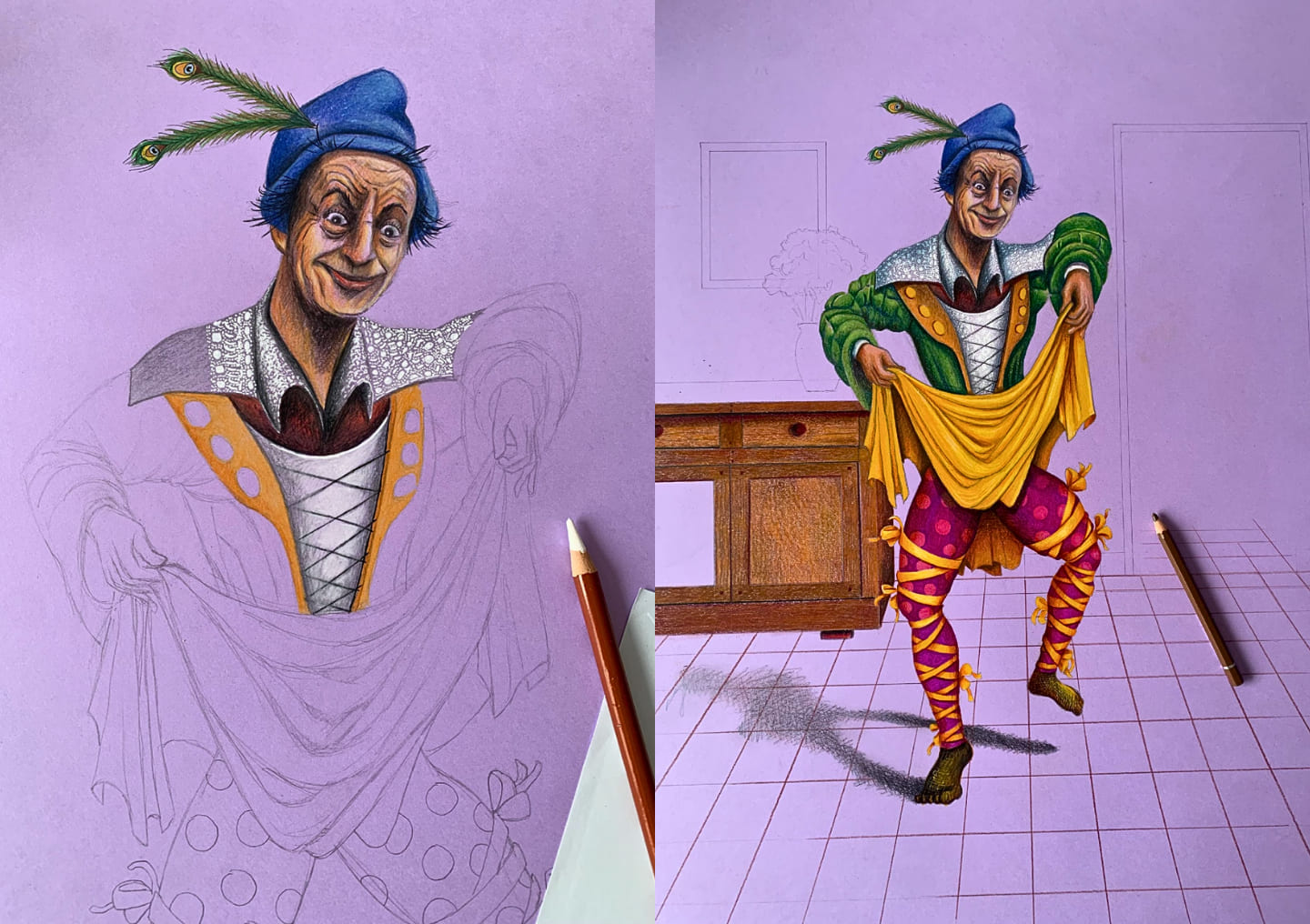
Fig. 4 : Sketches of Malvolio, Act III, scene 4.
Crédits : Jean-Louis Claret.
15The next step consisted in representing his full body. When it came to the famous yellow stockings, I felt compelled to reconsider the impact of the colour yellow on twentieth-century audiences. In the Renaissance, yellow was related to Judas and betrayal, whereas its symbolic negativity has largely faded today, even if some negative connotations remain. I felt that pink was more likely to provoke laughter and mockery nowadays. Consequently, Malvolio’s stockings became purple, dotted with pink circles.
16Yet yellow could not entirely disappear from the picture. I therefore introduced yellow ribbons woven up the steward’s legs, along with a sort of yellow apron that the clown lifts to reveal his supposedly irresistible attire. In this way, the colour chosen by Shakespeare – and that Olivia actually abhors – is partially restored. The discordant combination of yellow, purple, pink, and a green waistcoat emphasizes the chaotic dimension of the character’s attempt to seduce his mistress. Interestingly, this comic attempt at social and erotic advancement anticipates the dramatic mechanisms at work in John Webster’s tragedy, The Duchess of Malfi (1610).
17Behind Malvolio, I drew a piece of furniture on which I placed a basket of fruit and a white pot containing white flowers. Then, I began sketching lines to structure the floor. On the right-hand side of the image, I placed a doorway in which Maria appears, standing on the threshold with her arms akimbo. Next to her is Feste, whose tilted head emerges from behind the doorpost. In the background of the adjoining room, I placed a window opening on a sunlit Illyrian landscape. A painting representing Shakespeare – after the portrait by John Taylor – serves to mark the image explicitly as an illustration of one of his plays. This time, I positioned the curtain on the left side of the embedded picture. Malvolio’s shadow plays an essential role in giving the character solidity and in indicating that his left foot is uplifted. It becomes clear to the viewers that Malvolio is dancing.

Fig. 5 : Sketches of Malvolio, Act III, scene 4.
Crédits : Jean-Louis Claret.
18I felt that something should be added in the bottom right-hand corner in order to enhance the comic dimension of the scene. I therefore thought of introducing an animal symbolizing domestic life. The leaping cat in Lorenzo Lotto’s beautiful Annunciation immediately came to mind. I drew it in reverse orientation and placed its shadow beneath it. Incorporating an inter-iconic reference to an Annunciation within a depiction of Malvolio’s private performance before Olivia proved an irresistible temptation. After all, does not the steward proclaim – announce – his love and implicitly express his desire to unite with his mistress? The prospect of a baby’s birth comes naturally to mind.
19The final step in constructing the image consisted in drawing a circular mat beneath Malvolio’s feet. This idea was inspired by the posture of Jean de Dinteville in Holbein’s famous Ambassadors (1533). In Holbein’s painting, the right foot of the character on the left stands precisely at the centre of the circular pattern in the pavement – identified as the flagstones of Westminster Abbey. He is the main character, and he asserts his superiority. By contrast, the foot of Georges de Selve is placed close to the edge of the circle, thus suggesting a subordinate position. Accordingly, I reproduced the pattern of Holbein’s pavement and positioned Malvolio’s foot slightly off-centre. After all, he remains a servant, and, as such, he occupies a peripheral position. The square pattern of the floor also evokes the perspectival construction of Italian Renaissance paintings, while the convex mirror – a common ingredient in Flemish art – above the doorway may recall the Arnolfini Portrait (1434), subtly announcing the prospect of a marriage to come, at least in Malvolio’s wishful imaginings.
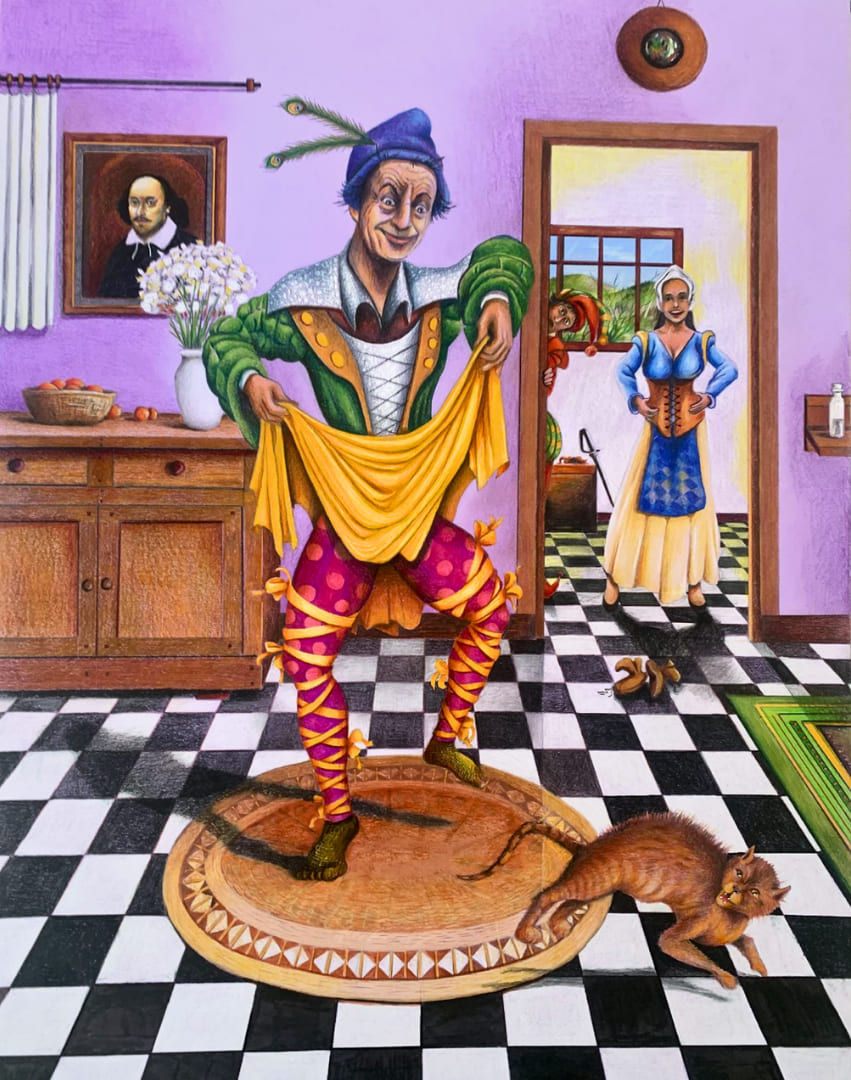
Fig. 6 : Malvolio, Act III, scene 4.
Crédits : Jean-Louis Claret.
The final scene
20The next illustration represents the final scene of Twelfth Night, when Viola and Sebastian face each other, leaving everyone around them in a state of utter dismay. Rather than depicting two identical characters confronting one another, as one may expect, I chose to account for the preceding scene, as illustrations often do. As a matter of fact, representing the scene that leads to the dénouement or to the final revelation allows observers to imagine the climax of the story for themselves.
21My first concern was to give a body and a face to Cesario. I spontaneously thought of a character I have drawn many times: the figure who stands next to the Antichrist in Luca Signorelli’s fresco The Preaching of the Antichrist, in Orvieto Cathedral. Apart from his left elbow, which is placed far too low and too far from the shoulder, the character possesses a certain “youth’s perfection” (I.5.288), and in him “all is semblative a woman’s part” (I.4.34).
22As I had planned to place Sebastian next to her, on the right, I positioned the character on the left side of the image and tilted it gently to the left. I endeavored to make her visage as feminine as I could.

Fig. 7 : Luca Signorelli, The Preaching of the Antichrist, fresco approx. 700 cm in width (betw.1499 and 1502), Orvieto Cathedral, Italy (left), Sketch of Sebastian, final scene (right).
Crédits : Public domain (left), Jean-Louis Claret (right).
23I then turned to Olivia and Sebastian. To draw the former, I used a beautiful painting by Henry Holiday titled Dante and Beatrice (1883). I took my cue from the representation of one of Beatrice’s waiting-women, dressed in red, and replaced the heroine in Holiday’s painting with Sebastian, whom I dressed like Viola. To make the parallel between them unmistakable, I adorned the hats of both characters with the same orange ostrich feathers.

Fig. 8 : Sketches of the final scene (Act V, scene 1).
Crédits : Jean-Louis Claret.
24I chose shades of blue for Olivia’s dress to create a contrast with the twins’ reddish garments. Next to them stands Orsino, who, like the other spectators on stage, is amazed by the ongoing scene. His name has clearly affected my perception of the character, whom I imagine as a potentially violent, even cruel, ruler. This is suggested by his willingness to “sacrifice the lamb that [he] do[es] love” (V.1.126) at the end of the play. There is a certain darkness in him, perhaps evoked by the image of the bear embedded in his name. I spontaneously turned to Diego Velásquez, whose portraits are often imbued with an atmosphere that seems appropriate. The Portrait of Juan de Pareja (1650), with its dark complexion, immediately struck me as a fitting rendition of the duke’s character. All I had to do was flip the picture to create a mirror effect, allowing him to look toward the group on the left side of the page.
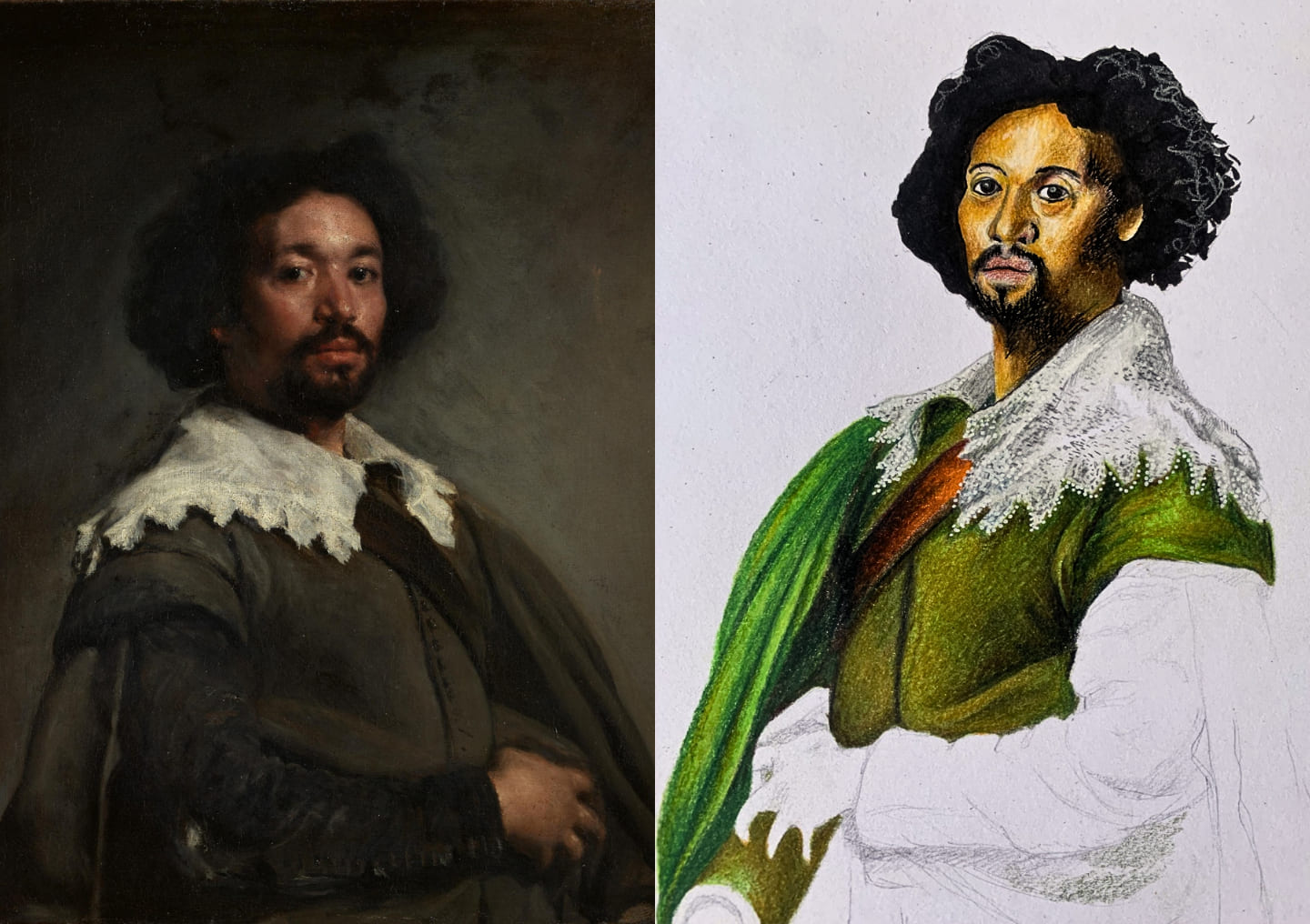
Fig. 9 : Diego Velásquez, The Portrait of Juan de Pareja (1650), oil on canvas, 81,3 × 69,9 cm.
Crédits : The Metropolitan Museum of Art, New York. CC0.
25I then added bookshelves to create a sense of perspective. My choice of books as a backdrop for this image remains somewhat mysterious, even for me, but I suspect the idea came from the importance Orsino gives to poetic inspiration in the opening scene. As he speaks like a well-read aristocrat who seems almost mesmerized with the lyricism of his own words – this is made clear by his valedictory lines: “Away before me to sweet beds of flowers: / Love-thoughts lie rich when canopied with bowers” (I.1.39-40) –, I thought it fit to place rows of books behind the characters. Since Feste is not present when the twins are reunited, I replaced him with a portrait positioned between Cesario and Olivia. He, too, seems to be upset by the ongoing scene.
26As in my previous illustration, I included an animal symbolizing domesticity. This time, I chose the dog at the feet of the Arnolfini couple in Jan van Eyck’s famous painting. Making the floor yellow enabled me to enhance the colours of the clothing. The vertical lines on the back wall echo those formed by the books, while the green curtain on the left is a modest echo of the sumptuous drapery that Holbein painted behind the figures in The Ambassadors.
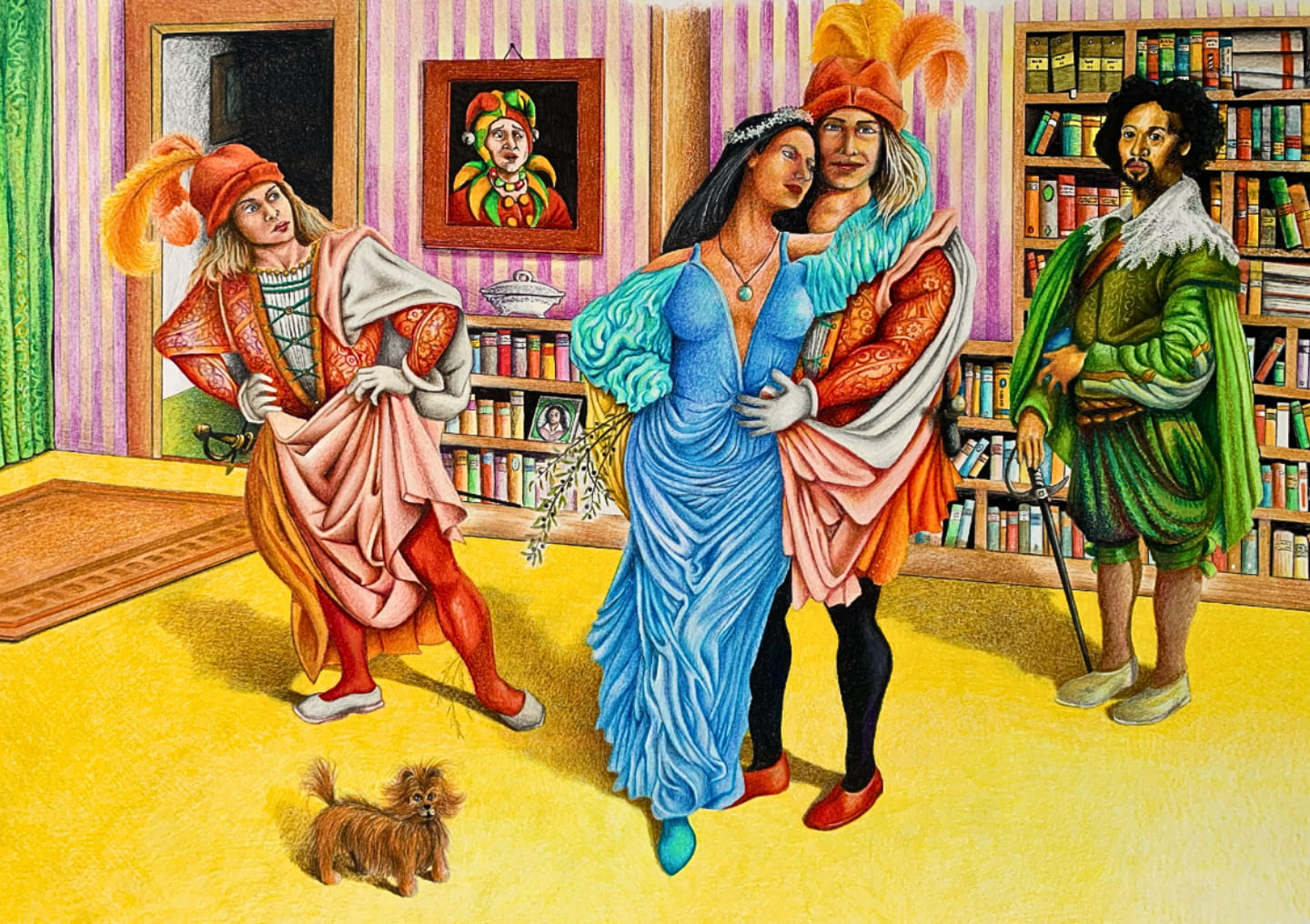
Fig. 10 : The Final Scene (Act V, scene 1).
Crédits : Jean-Louis Claret.
Portraits: where my hand leads me…
27The following illustrations present a selection of characters. The first I would like to discuss is my rendition of Sir Andrew Aguecheek. This character is clearly a gullible victim of Sir Toby. Like Roderigo in Othello, he hopes to gain access to a noblewoman’s bed by giving money to a self-appointed procurer. Yet, as in Shakespeare’s tragedy, the go-between is merely deceiving his fellow merrymaker: Sir Toby, like Iago, manipulates his companion for his own amusement. Andrew remains the laughingstock of the comedy until Malvolio unwittingly takes over that role.
28Even though Sir Andrew is unlikely to arouse much sympathy from the audience, he is nonetheless given a line that can radically alter our perception of him. As a matter of fact, amidst a series of ludicrous assertions, the fool suddenly declares: “I was adored once too” (II.3.176). Even though this statement belongs to a sequence of echoes that turn Andrew into something of a parrot figure, the way it is delivered on stage may give it unsuspected depth and emotional resonance. A comedian may choose to emphasize the character’s dismay as he utters the line, thereby revealing a crack beneath Andrew’s glossy surface. I was struck by what I consider an unexpected, humanizing revelation. Like most of the characters in Twelfth Night, Andrew loved, was loved, and then lost his lover. After all, even clowns may suffer. These words suggest that the essence of happiness is tragic.
29The line “I was adored once too” put me in mind of the sad face of a painted figure in a masterpiece by Peter Bruegel, The Peasant Wedding (1567). I have always been puzzled by the presence of a man dressed in black on the far right of the famous painting, now housed in the Kunsthistorisches Museum in Vienna.

Fig. 11 : Peter Bruegel, The Peasant Wedding (1567), oil on wooden panel, 114 × 164 cm (left), Sketch of Andrew ‘I was adored once too’ (right).
Crédits : Public domain. Kunsthistorisches Museum, Vienna (left), Jean-Louis Claret (right).
30While the other characters seem to be enjoying the wedding feast, he is engaged in conversation with a monk; he looks sullen and, rather surprisingly in this context, carries a sword. Moreover, unlike the other guests, he is seated on an upturned wooden basin beneath which lies a mysterious playing dice displaying the number two, while the face visible to the observer shows a four. Like this odd figure, Andrew is an outsider – and one whom the other characters ridicule. As a nouveau riche, he is treated as socially inferior, and even Maria looks down on him, as suggested by her lively exchange with Sir Toby in Act I, Scene 3 (14-35). I copied the painted man’s face and cap, though I coloured the ribbon around the cap green. I also transformed his black coat into a deep blue one and tried to give him an introspective gaze, after carefully combing his long moustache.
31Next to him, I placed the fading visage of a young person emerging from – or dissolving into – the grey sheet of paper. The absence of colour indicates that this figure is a mental creation, a mere illusion conjured up by the man’s introspective gaze. Like the Virgin in Jan van Eyck’s Madonna of Chancellor Rolin, the character the hero appears to be looking at is not actually present: it is a projection of his mind, a visible absence. I wanted to draw an androgynous face, although my model was the twelve-year-old daughter of a friend. As for the dancers at the bottom of the page, I borrowed them from Bruegel’s The Peasant Dance (1567). The houses and the steeple in the background, in the lower part of the image, are also inspired by that painting. The juxtaposition of the large, solitary figure and the dancing peasants suggests a fusion of Shakespeare’s and Bruegel’s worlds. In this way, Sir Andrew’s outlandishness finds two distinct visual incarnations.
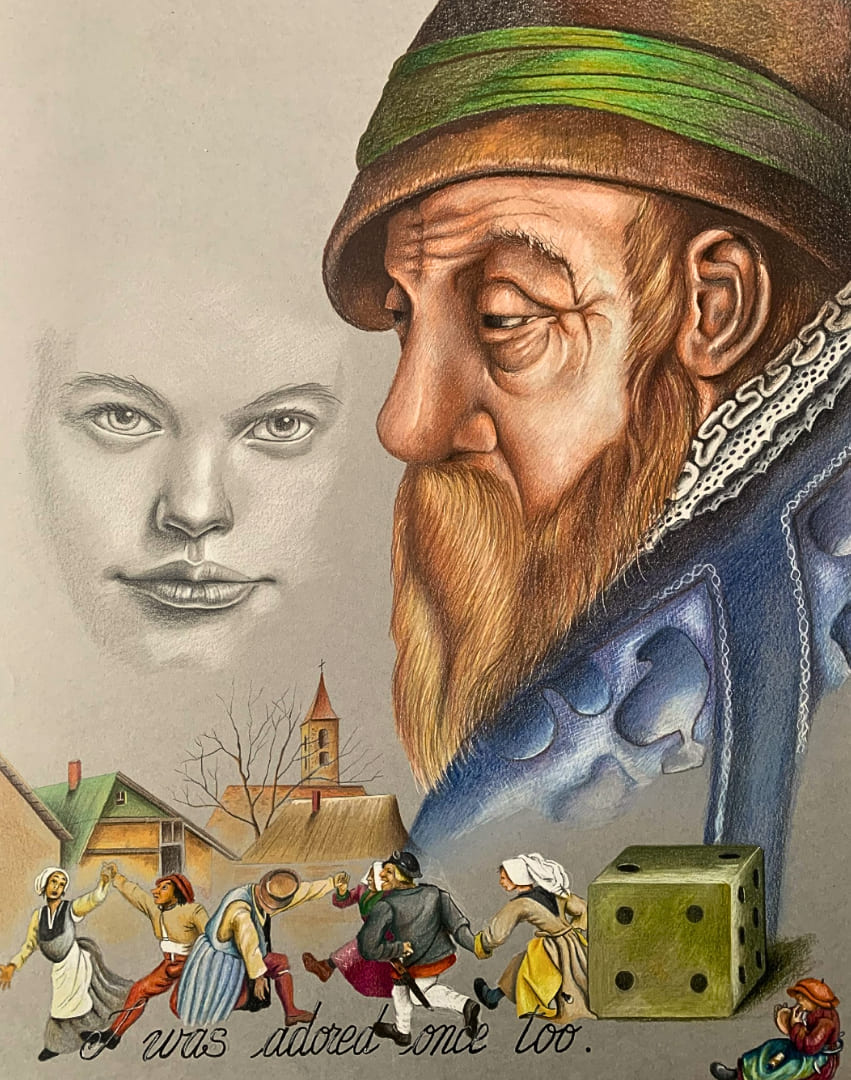
Fig. 12 : Andrew ‘I was adored once too’.
Crédits : Jean-Louis Claret.
32Olivia is a puzzling character. She vows to withdraw into her palace and mourn for seven years, only to fall in love overnight with a young man she has never seen before. She veils her face, only to unveil it again, and asks the boy she has just dismissed to return soon. Yet, what caught my attention, more than the contradictions that contribute to defining her, was her name.
33Olivia evokes the olive that Cesario claims he “holds in [his] hand” (I.5.204). The olive branch inevitably recalls the episode in Genesis when Noah sends out a dove to discover whether the waters have receded after the Flood, following the raven that never returned. The dove returns with an olive branch in its beak. At last, hope becomes possible. Her name also contains the letters of Viola’s name, which she hears for the first time at the end of the play (V.1.237), when the twins eventually confront each other. It is almost as though a process of logophagy were at work, producing a strange form of lexical pregnancy. Olivia also contains most of the letters that make up “Malvolio”: only the letter M is missing. Interestingly, the same letter is missing from “Iago”. If it were restored, the word Imago (I[m]ago) would suddenly appear.
34Since Shakespeare clearly enjoyed playing with the names of his characters, I felt entitled to do the same. I therefore began by drawing a woman’s face spontaneously, almost out of nowhere.
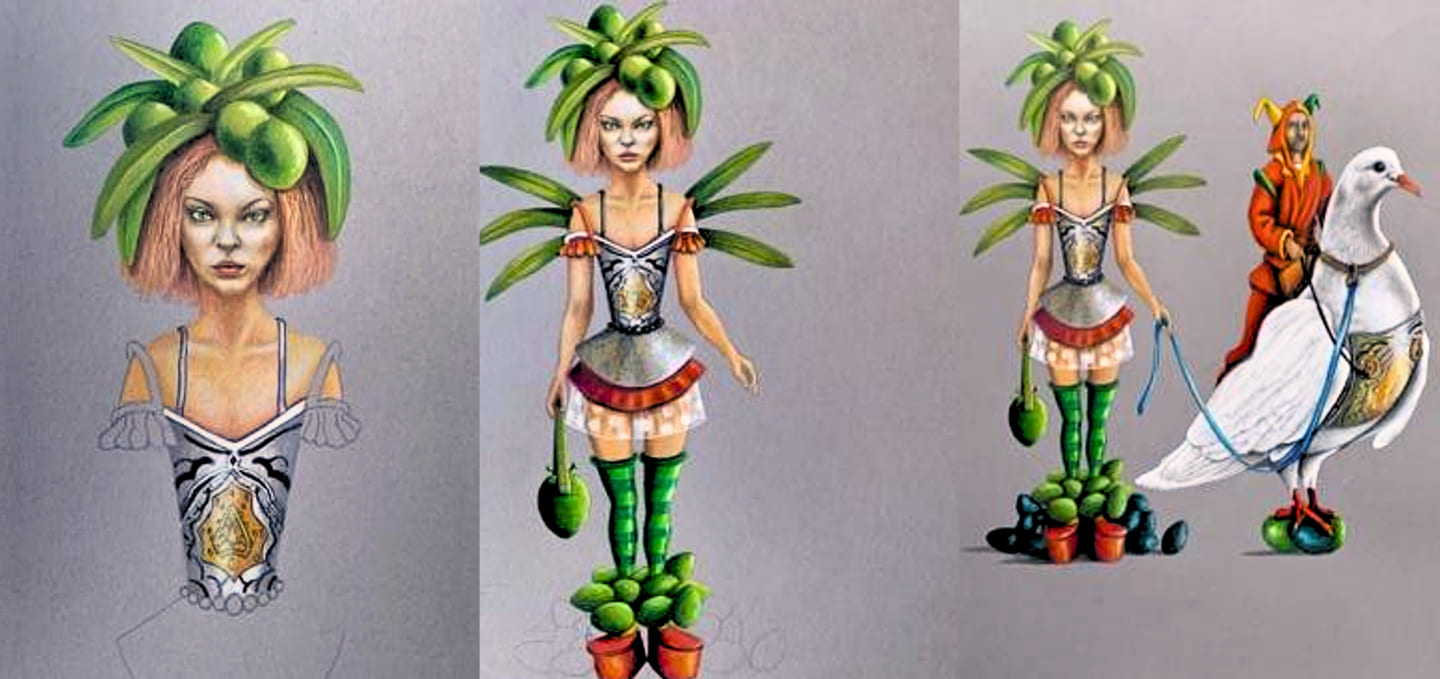
Fig. 13 : Three sketches of Olivia.
Crédits : Jean-Louis Claret.
35I let my hand wander and soon found myself placing large olives and olive leaves on her head. I then proceeded to draw garments inspired by Bronzino’s beautiful 1454 portrait of Eleanor of Toledo with her son. I must confess that I have always been fond of the intricate pattern in her magnificent dress. Although my drawings are always realistic, I wanted Olivia to appear somewhat strange.
36I therefore gave her a very narrow chest and a pair of long legs. Wing-like olive leaves stick out from her back, and her handbag is itself an olive. I also buried her ankles beneath a pile of olives. Knowing that I wanted her to hold something that I would place on her left, I raised her left hand accordingly. The idea of her armour-like skirt also derives from the influence of the pattern in Bronzino’s dress.
37The idea of the dove came naturally, as the white bird is closely associated with the notion of peace. Since this drawing was already tending toward the fantastical, I decided to depict a huge bird and, to my own surprise, placed Feste on its back. The bird’s armour echoes Olivia’s bodice, and the fact that it stands on olives may easily go unnoticed. Because the whole thing seems made of such stuff as dreams are made on, I felt that more colours were required. I therefore scattered a series of large decorative balloons across the scene.
38In the end, the whole picture amounts to a series of variations on the name Olivia, intended to echo visually the way the play itself deals with the letters that compose it. It became a playground for my mischievous hand.
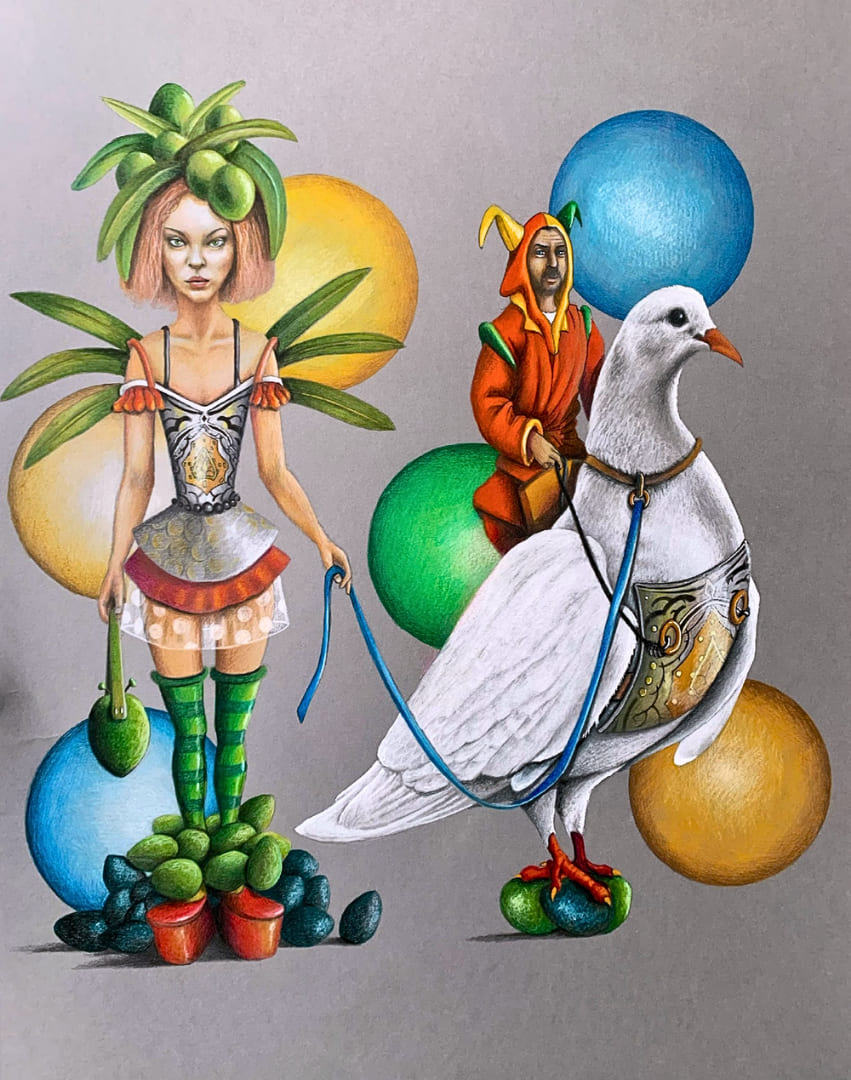
Fig. 14 : Olivia.
Crédits : Jean-Louis Claret.
39I allowed my hand a similar freedom in my rendition of Malvolio. I was torn between the desire to combine laudatory interior and scornful exterior views of the character. The former are largely entertained by the steward himself. He is in love with himself, as suggested by his attitude towards his own shadow. Olivia confirms this view when she declares: “O, you are sick of self-love, Malvolio” (I.5.86). Even though this line might seem even more appropriate if applied to Orsino – whose love for Olivia appears deflected toward himself, as “[his] desires, like fell and hungry hounds, / E’er since pursue[ing him]” (I.1.21-22) – Malvolio undoubtedly has an excessively high opinion of himself.
40Accordingly, I sought to depict a dignified character whose underlying folly might paradoxically be visible at first sight. So, I drew a very austere figure, identifiable thanks to the small badge on his suit. While colouring his face, my hand began to draw diagonal lines across it. I allowed the gesture to continue, filling every second space with flesh colour. Then, almost unconsciously, I reached for a yellow pencil.
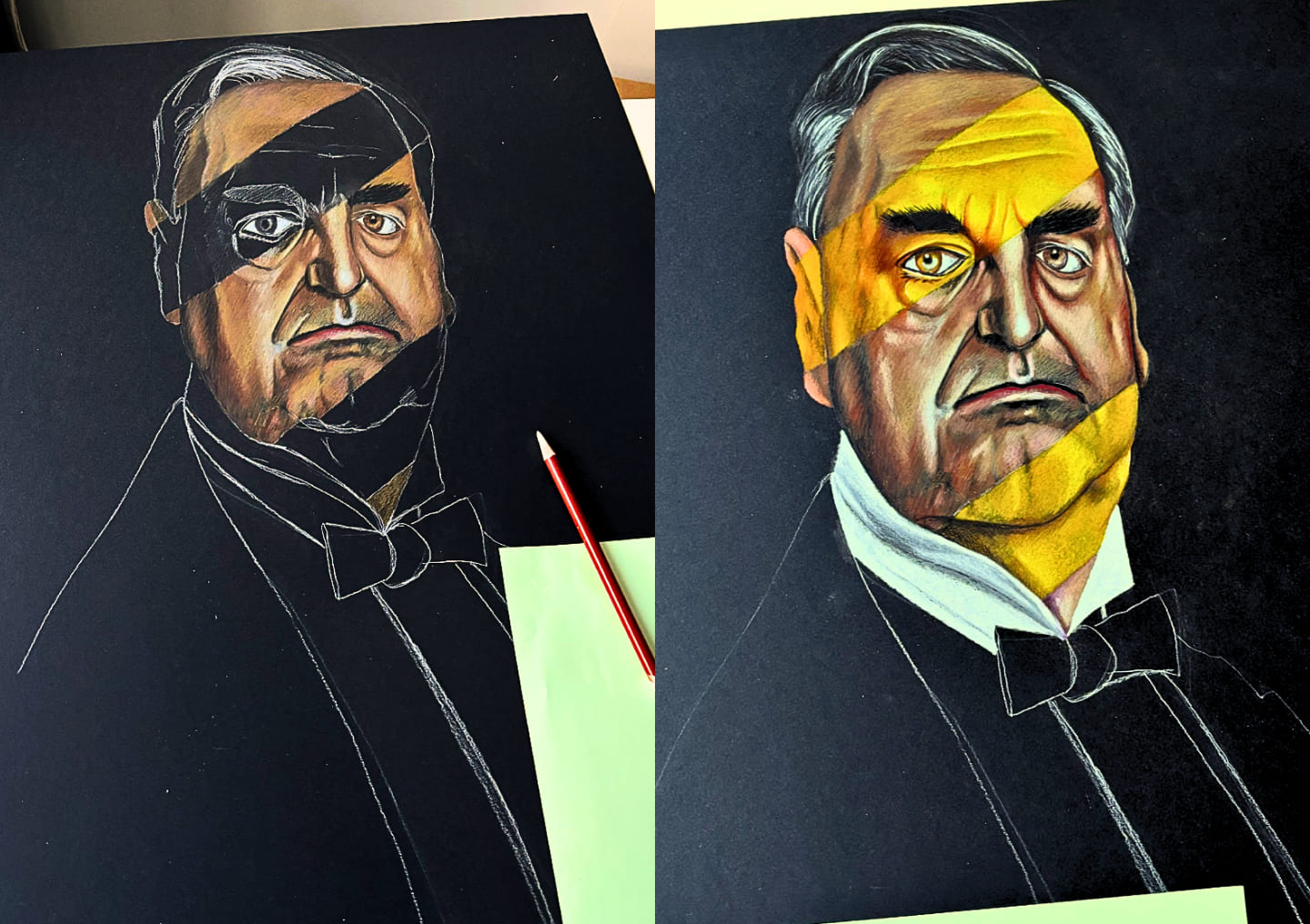
Fig. 15 : Sketches of ‘Count Malvolio’ (Act II, scene 5).
Crédits : Jean-Louis Claret.
41The resulting stripes across Malvolio’s face account for his doubleness. Both a servant and an aspiring “Count Malvolio” (II.5.32), he is sure to raise mixed feelings in the minds of the spectators. Nevertheless, one may be puzzled by the apparently excessive – even unfair – reactions some nineteenth-century writers expressed toward this character.
42For example, in Dracula (1897), Bram Stoker mentions Malvolio in a very surprising context. While describing Renfield – Dracula’s servant locked up in Dr Seward’s mental institute – the doctor observes his patient collecting flies to feed spiders and remarks: “‘What about the flies these times?’ He smiled on me in quite a superior sort of way – such a smile as would have become the face of Malvolio – as he answered me”.3 Stoker’s comparison clearly stems from Renfield’s air of superiority, yet the link it establishes between Dracula and the countess is somewhat disquieting – unless the monster the puritan serves is a dark force at work within his own mind, as the exorcism scene at the end of Twelfth Night might suggest.
43This curious literary legacy may explain why my hand instinctively reached out for a yellow pencil to fill the empty spaces in Malvolio’s visage. It is, after all, the colour Olivia abhors (II.5.193). Moreover, it carried strongly negative connotations during the early modern period, as Michel Pastoureau has shown in his study devoted to this colour.4
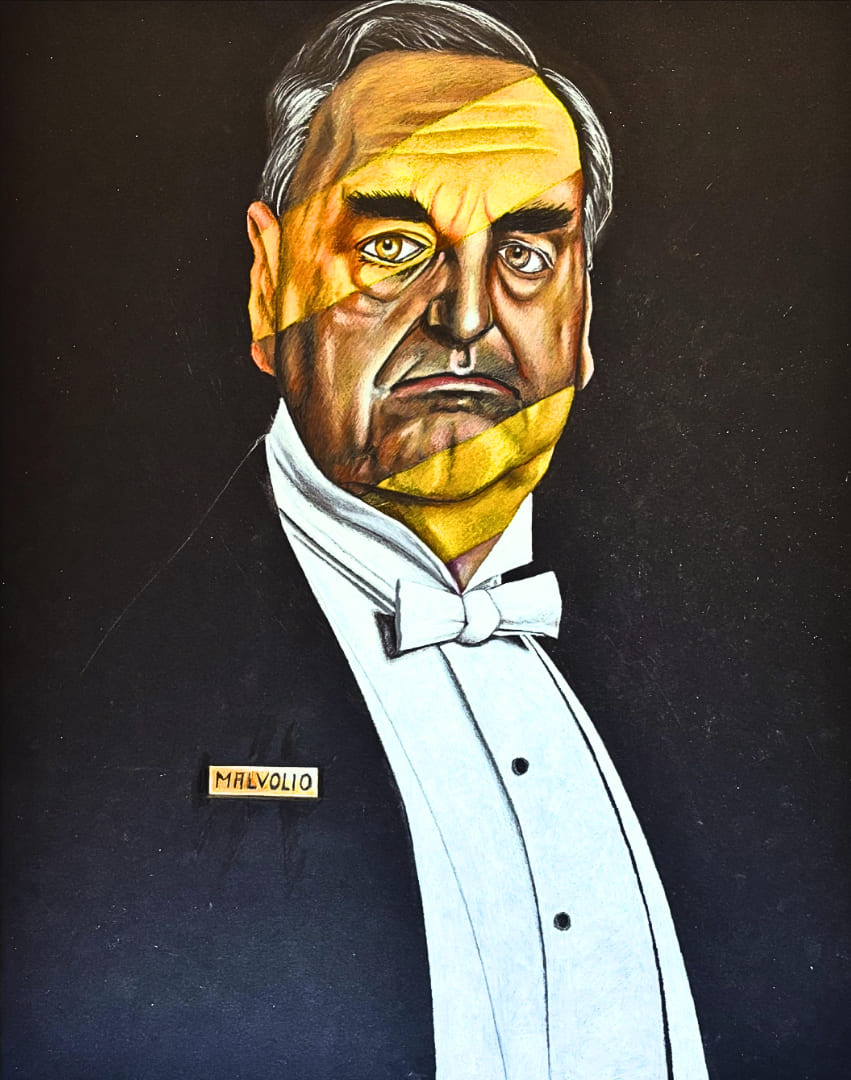
Fig. 16 : Count Malvolio (Act II, scene 5).
Crédits : Jean-Louis Claret.
44The next drawing was prompted by a line mentioned earlier: “O, you are sick of self-love, Malvolio” (I.5.86) – which I inscribed at the bottom of the image. Rather than depicting the character targeted by the remark, I felt like representing the idea conveyed by the line itself. These words resonated deeply and put me in mind of a great painter who seemed so enamoured of his own image that he produced around one hundred self-portraits,5 portraying himself from adolescence to old age: Rembrandt. I therefore set myself the challenge of attempting to render the effect of an oil painting using coloured pencils.
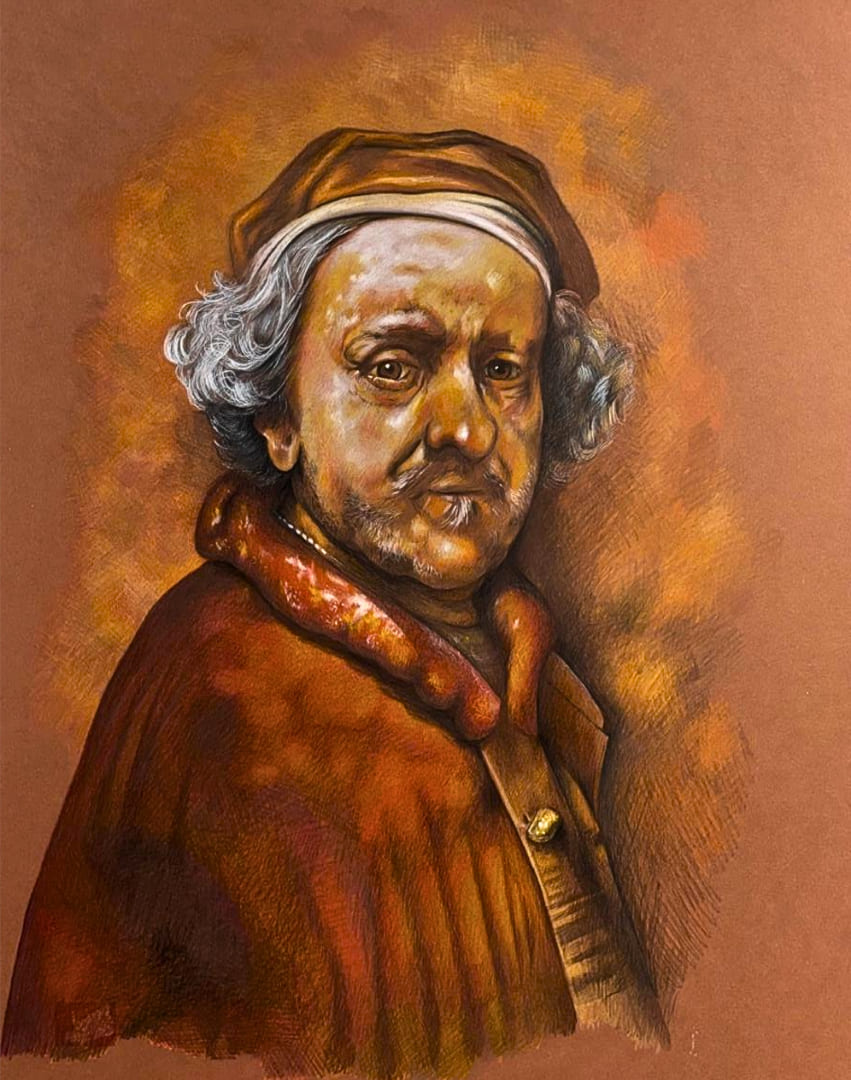
Fig. 17 : “O, you are sick of self-love, Malvolio” (I.5.86).
Crédits : Jean-Louis Claret.
45The final drawing I made in this Twelfth Night series can likewise be described as the visual transposition of a line. “Wise enough to play the fool” (III.1.38) is indeed a powerful phrase that perfectly captures Feste and his fellow jesters in Shakespeare’s plays.6 My approach consisted in pairing a famous representative of wisdom with the attributes of a court jester. Since the play repeatedly questions the notion of identity7 -- echoing Hamlet’s famous dilemma, “to be or not to be” – I thought of René Descartes’s well-known statement from the Discours de la méthode (1637), “Je pense, donc je suis”. For reasons that remain somewhat mysterious to me, the thought of the French philosopher put me in mind of the colour blue. So, I reached for a blue sheet of paper. As I needed a model, I turned to the famous portrait of Descartes after Frans Hals and copied it. The influence of Maurice Lever’s Le Sceptre et la marotte8 led me to use the coxcomb as an unmistakable attribute of the fool. I painted it in the conventional colours of folly – red, yellow, and green – which Bruegel used to depict a jester in his famous Fight Between Carnival and Lent.9 The result is a curious blend of classicism and incongruity.
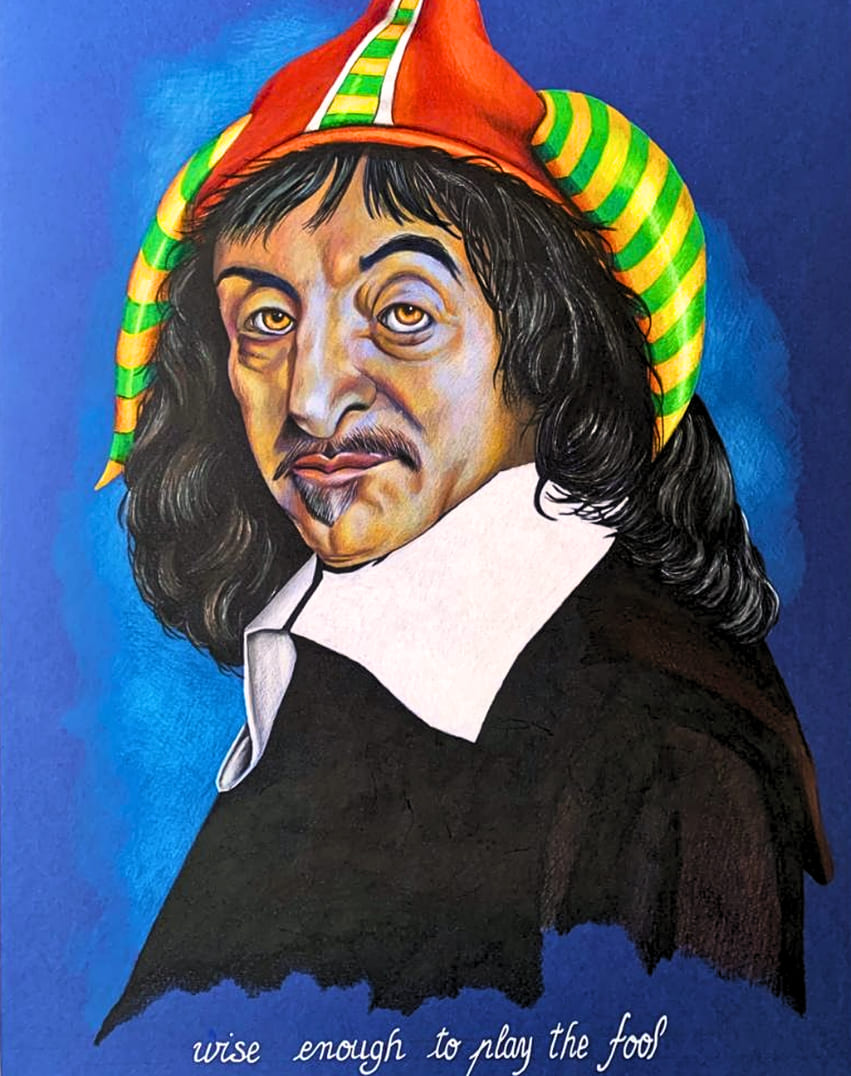
Fig. 18 : “Wise enough to play the fool” (3.1.38).
Crédits : Jean-Louis Claret.
46Taken together, this series of illustrations constitutes a kind of visual exegesis of Shakespeare’s play, mediated through images. Born from the experience of reading Twelfth Night, they attempt to transpose the poetic impact of the characters’ exchanges into visual form. The playwright’s words made their way through my mind and were metamorphosed into mental images that my hand sought to render visible. At times, the final drawings remained faithful to these ghostly visions; at others, they diverged from them, raising questions about the reliability of the process itself. Yet the unexpected shifts that reveal the hand’s capacity to improvise – express things that the mind had not anticipated – may prove fruitful. Bypassing the intellect and giving a free rein to the hand may sometimes lead to a more spontaneous, unfiltered form of truth. In this way, I may eventually learn lessons from my own drawings and begin a silent dialogue with the images I create.
Bibliographie
CLARET, Jean-Louis, « Les mondes opposés dans Twelfth Night de Shakespeare et Le Combat de Carnaval et Carême de Pieter Bruegel l’Ancien », in Twelfth Night, Or What You Will, Catherine Lisak (ed.), Paris, Ellipses, 2024.
LEVER, Maurice, Le Sceptre et la marotte : Histoire des fous de cour, Paris, Hachette, 1985.
PASTOUREAU, Michel, Jaune, Paris, Seuil, 2019.
SHAKESPEARE, William, Twelfth Night, or What You Will, ed. Keir Elam, Arden Shakespeare, Third Series, London, Bloomsbury Arden Shakespeare, 2008.
STOKER, Bram, Dracula, London, Penguin Classics, 2003.
Notes
1 I am using the following the edition: William Shakespeare, Twelfth Night, or What You Will, ed. Keir Elam, Arden Shakespeare, Third Series, London, Bloomsbury Arden Shakespeare, 2008.
2 All my compositions are dated 2025 and have the same dimensions and technique.
3 Bram Stoker, Dracula, London, Penguin Classics, 2003, p. 286.
4 Michel Pastoureau, Jaune, Paris, Seuil, 2019.
5 The exact number of self-portraits is being disputed as some were probably copied by members of his studio or admirers.
6 One may also think of Touchstone in As You Like It.
7 For example, “I am not that I play” (1.5.179), “I am not what I am” (3.1.139), “I would you were as I would you be” (3.1.140).
8 Maurice Lever, Le Sceptre et la marott: Histoire des fous de cour, Paris, Hachette, 1985.
9 À ce sujet, voir Jean-Louis Claret, « Les mondes opposés dans Twelfth Night de Shakespeare et Le Combat de Carnaval et Carême de Pieter Bruegel l’Ancien », in Twelfth Night, Or What You Will, Catherine Lisak (ed.), Paris, Ellipses, 2024, p. 31-58.
Pour citer ce document
Quelques mots à propos de : Jean-Louis Claret
Droits d'auteur

This is an Open Access article distributed under the terms of the Creative Commons Attribution License CC BY-NC 3.0 (https://creativecommons.org/licenses/by-nc/3.0/fr/) / Article distribué selon les termes de la licence Creative Commons CC BY-NC.3.0 (https://creativecommons.org/licenses/by-nc/3.0/fr/)